Did you know that Mallorca has been exporting cheese to the rest of the Mediterranean for centuries? If you are interested in the island’s gastronomy beyond sobrasada and olive oil, the artisan cheeses produced on its farms and family dairies are a must-stop. In this article you will find everything you need to know: history, varieties, local production process, quality certifications and, above all, how to pair these Mallorcan artisan cheeses with an extra virgin olive oil from the island such as Finca Treurer’s.
Article contents
- A cheesemaking tradition with centuries of history
- The raw material: breeds and milks of the island
- The artisan production process: from milking to the cave
- Main varieties of Mallorcan cheeses
- Certifications and quality seals
- Where to find artisan cheeses in Mallorca
- The cheese-oil pairing: a Mediterranean tradition
- How to pair Mallorcan cheeses with Treurer oil
- A simple recipe: cured cheese toast with Treurer oil
- A gastronomic experience worth living on the island
Contenidos / Contents
A cheesemaking tradition with centuries of history
Cheese production in Mallorca has a history stretching back centuries. The first documented records date from the 13th century, with the shipment to France of artisan cheeses made from sheep’s milk in the Llucmajor region, pieces of approximately 2.5 kilograms destined for cities such as Montpellier and Marseille.
Mallorcan cheese was the most traded in the western Mediterranean during the Late Middle Ages, which speaks of a consolidated cheesemaking industry long before the island became a tourist destination. Over time, the tradition of making artisan cheeses in Mallorca was enriched by Arab, European and local influences, giving rise to a variety of unique cheeses.
Today that heritage lives on in family dairies spread across the island, where artisans continue to combine ancestral techniques with modern quality criteria. The local production of artisan cheeses is kept alive thanks to native breeds and a raw material that Mallorca’s Mediterranean climate makes especially rich. According to data from the Balearic agri-food sector, the island currently has more than twenty active artisan dairies, most of them family-run with an annual production not exceeding 50,000 kilograms per establishment.
The raw material: breeds and milks of the island
The character of an artisan cheese begins with the animal and what it eats. In Mallorca, three main sources of milk for making artisan cheeses coexist, each with a distinct organoleptic profile.
The Mallorcan red sheep, an autochthonous gem
Mallorcan red sheep cheese is par excellence the island’s typical cheese, made from the milk of a native breed perfectly adapted to the island’s climate and landscape. This sheep produces a rich and aromatic milk with its own personality, though in modest quantities: its milk yield is notably lower than that of continental breeds such as the churra or manchega, making each piece a genuinely scarce product.
The production season is concentrated between November and May, when the sheep are in lactation. Outside that period, fresh Mallorcan red sheep cheeses disappear from the dairies and can only be found in advanced stages of curing, made during the preceding months. The rennet used is vegetable — extracted from thistle — which gives a texture and flavour that artisan cheeses of industrial production can hardly replicate.
Goat and cow: versatility and creaminess
Mallorca also produces a variety of artisan goat cheeses, characterised by their distinctive and mild flavour. These cheeses can vary in texture, from soft and creamy to firm and more pronounced, depending on the ripening time.
The island also produces artisan cheeses from raw sheep’s milk, a mixture of sheep and goat, and also from cow’s milk. Unlike Menorca, where cow’s milk cheeses are usually made with raw milk, in Mallorca the milk is pasteurised before curdling. This difference in process gives rise to softer cheeses with a more milky profile, ideal for those new to the world of Mallorcan artisan cheeses.
Seasonality and availability throughout the year
The Mallorcan red sheep’s dependence on the natural lactation cycle has a direct consequence in shops and markets: from June to October, fresh sheep’s milk cheeses become scarce or disappear altogether. During those months, artisan producers compensate the supply with goat cheeses — whose lactation period is longer — and with advanced-curing sheep pieces made during the winter. If you visit the island in summer and want to take home a Mallorcan red sheep artisan cheese, look for the semi-cured or cured stages: these are the ones that will have survived the wait and will be at their best.
The artisan production process: from milking to the cave
Understanding how an artisan cheese is made is understanding why it tastes different. Local production in Mallorca follows a short chain that preserves the character of the product at every step.
The production process of these artisan cheeses includes a characteristic manual pressing, an exterior salting with local sea salt and a maturation that can last from a few months to more than a year. Each phase leaves its mark on the final result.
Fresh cheese is the result of curdled milk without any fermentation. For semi-cured and cured artisan cheeses, on the other hand, fermentation is necessary, and it is this that gives the piece its flavour and texture.
Artisans make semi-cured cheese with a maturation of around 40 days; cured, with five months; and old cheese, with a minimum of one year of maturation. The latter, with its firm rind and compact paste, is the one that best withstands pairing with characterful oils.
Main varieties of Mallorcan cheeses
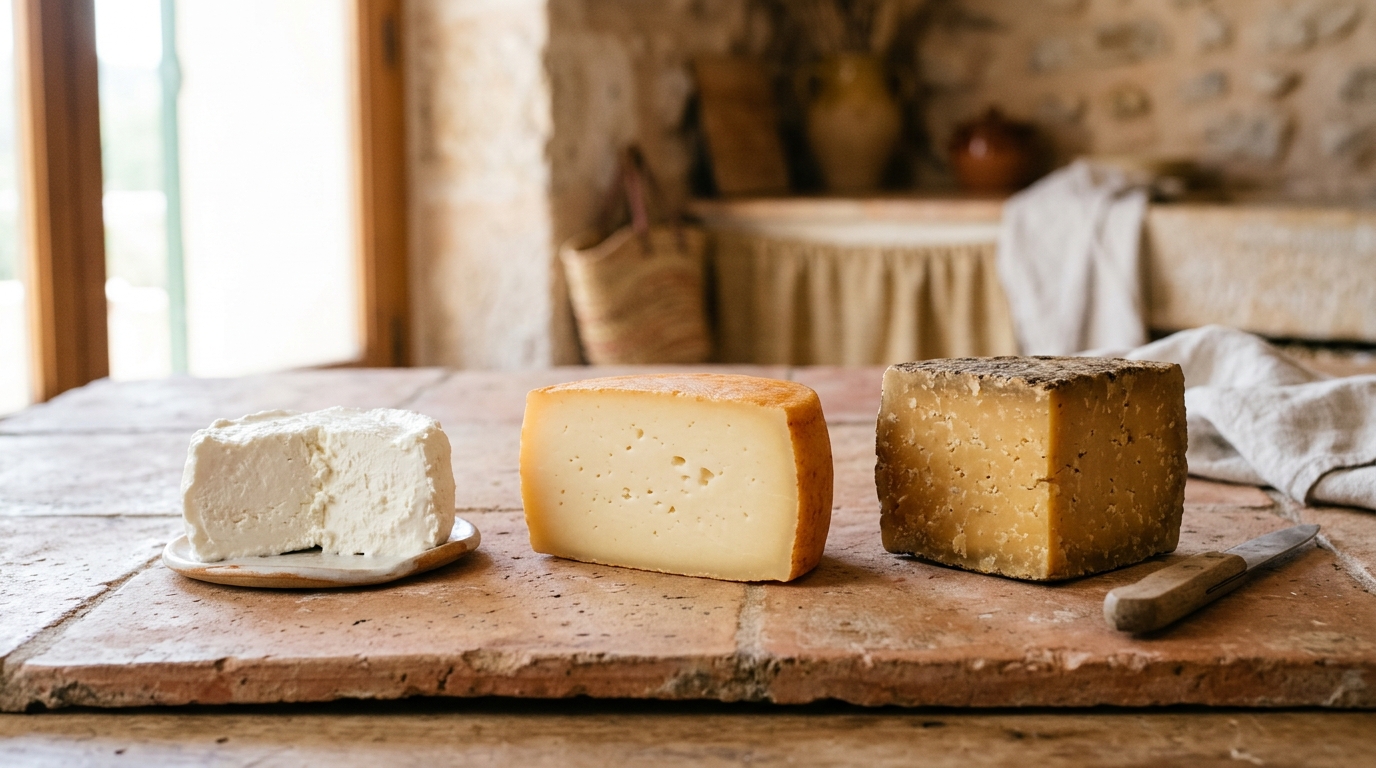
The island’s cheese landscape is more diverse than many visitors imagine. Beyond the generic “Mallorcan cheese”, there are well-differentiated profiles worth knowing before sitting down to an artisan cheese tasting board.
Flavour and texture vary according to curing time: fresh cheese is soft and creamy, semi-cured offers a more intense flavour and firmer texture, while cured is powerful and persistent on the palate.
Among the artisan cheeses with the greatest projection outside the island, those made with Mallorcan red sheep’s milk stand out, recognised at international competitions such as the World Cheese Awards. In 2021, the Son Jover dairy received a bronze medal at that competition with an organic cured Mallorcan red sheep cheese.
Also worth mentioning is fresh cow’s cheese, highly sought after in local markets for its delicate texture and versatility in cooking. Dairies such as Es Cabàs, specialising in sheep and goat milk, offer artisan cheeses with authentic flavours and a maturation process that gives them an unmistakable taste.
Certifications and quality seals: what they guarantee the buyer
One of the most frequent questions among those approaching Mallorcan artisan cheeses for the first time is: how do I know I am buying a truly artisan product and not an industrial one with a pretty label? The answer lies in quality seals, which in Mallorca act as a compass for the consumer.
Marca Balear: the institutional umbrella
The Marca Balear is the quality seal of the Govern de les Illes Balears that certifies agri-food products made on the islands with local raw materials and under controlled production standards. For artisan cheeses, obtaining this distinction involves passing periodic audits that verify the origin of the milk, the production conditions and compliance with traceability criteria. Not all producers apply for it — the certification process has a cost — but when it appears on the label it is a solid guarantee of origin and quality.
Certified organic production
Several artisan cheese producers in Mallorca work under the organic farming seal regulated by the Consell Balear de la Producció Agrària Ecològica (CBPAE). This means that the animals are raised without preventive antibiotics, fed on GMO-free feed and in verified animal welfare conditions. The organic cured cheese from Son Jover, awarded at the World Cheese Awards, is a good example of how organic certification and international recognition can go hand in hand.
International competitions as a seal of excellence
Unlike Mahón-Menorca cheese, which has its own Protected Designation of Origin (PDO), Mallorcan artisan cheeses do not have a specific PDO. However, the active participation of Mallorcan producers in competitions such as the World Cheese Awards or the National Cheese Competition of Spain serves as an alternative quality endorsement: the medals obtained at these events are verifiable and public, allowing the informed buyer to check the producer’s reputation before purchasing a piece. When you see a Mallorcan artisan cheese with a medal sticker, it is not marketing: it is a result audited by international panels of experts.
Where to find artisan cheeses in Mallorca
The best way to discover Mallorcan artisan cheeses is to go directly to the source. Gastronomic fairs and local markets are the best showcase for finding Mallorcan red sheep cheese, artisan goat creations and other singular blends. Below are some of the most recommended dairies and points of sale:
- Son Jover (Inca): certified organic dairy, specialising in Mallorcan red sheep. Direct sales at the farm and at local markets. Awarded at the World Cheese Awards 2021.
- Formatges Burguera (Campos): one of the island’s most traditional dairies, with a wide range of cured and semi-cured cheeses. Own shop open to the public Monday to Saturday.
- Es Cabàs (Llucmajor): specialising in sheep and goat milk, with artisan cheeses of a very authentic profile. Sales at local markets and at their dairy.
- Grimalt (Es Llombards, Santanyí): produces with pasteurised cow’s milk. Their cheeses — cured, semi-cured and fresh — can be found in local supermarkets and markets in the Migjorn area.
- Menestralia: an artisan dairy that innovates in flavours and techniques, with artisan cheeses incorporating local ingredients such as island herbs or paprika. Present at gastronomic fairs and specialist shops in Palma.
- Mercat de l’Olivar (Palma): the capital’s central market concentrates several stalls with Mallorcan artisan cheeses from different producers, open Monday to Saturday mornings.
- Sineu Market (Wednesdays): one of the most authentic weekly markets in the island’s interior, with regular presence of local artisan cheese producers and other agri-food products.
In Mallorca, routes such as the olive oil route in the Serra de Tramuntana stand out, where you can visit family oil mills and wineries, and which complement perfectly with a stop at one of the dairies in the island’s interior. Combining a visit to Finca Treurer with a route through local artisan cheese producers is, without doubt, one of the most complete gastronomic experiences the island has to offer.
The cheese-oil pairing: a Mediterranean tradition
Cheese and extra virgin olive oil contain within themselves the DNA of the Mediterranean diet. They are two of the cornerstones upon which our food tradition has been built.
The first pairings were born out of the need to extend the shelf life of cheese: immersing it in olive oil was a way of preserving it for longer. From that interaction came artisan cheeses in olive oil, aromatic, intense and juicy.
What began as a preservation technique became one of the most celebrated combinations in Mediterranean gastronomy. The cheese-oil pairing works because both products share a fat base that acts as a vehicle for aromas, amplifying the nuances of each without either cancelling out the other.
How to pair Mallorcan cheeses with Treurer oil
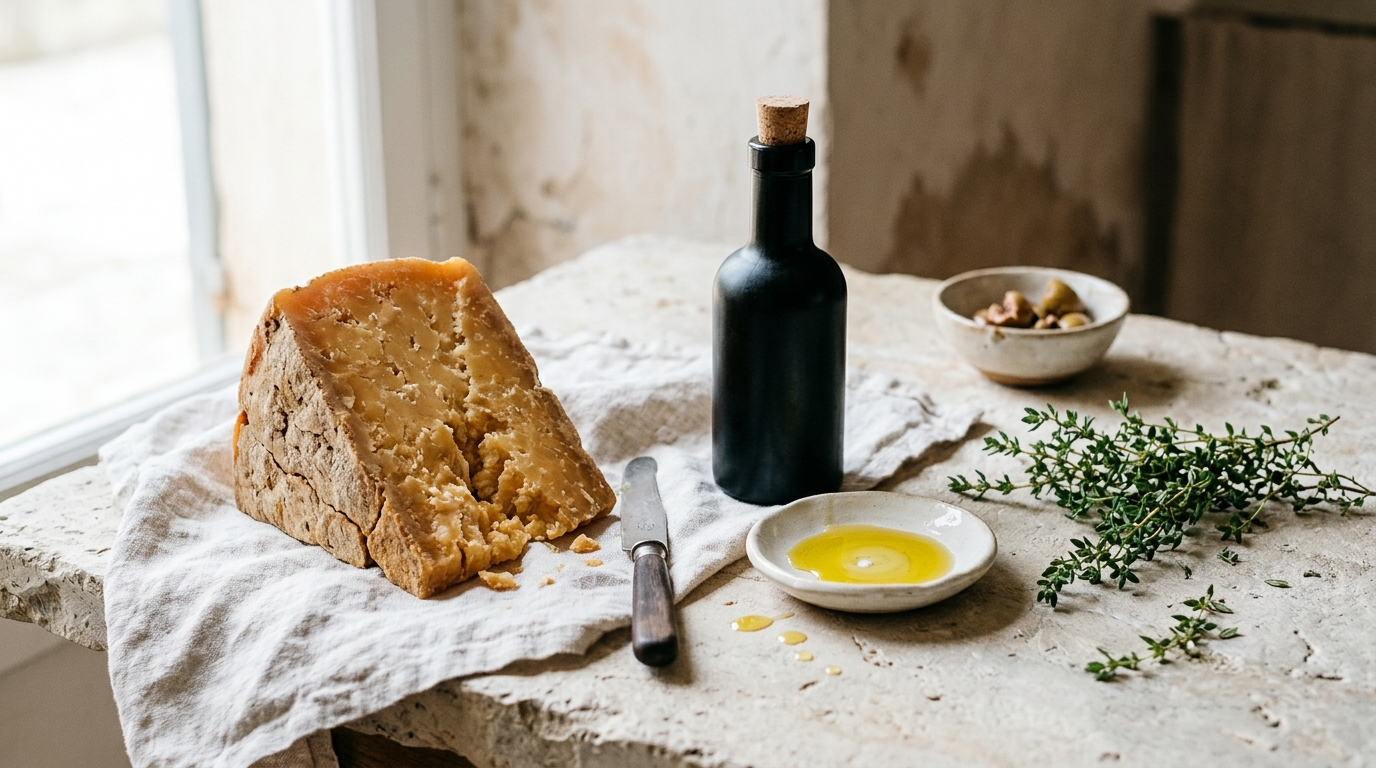
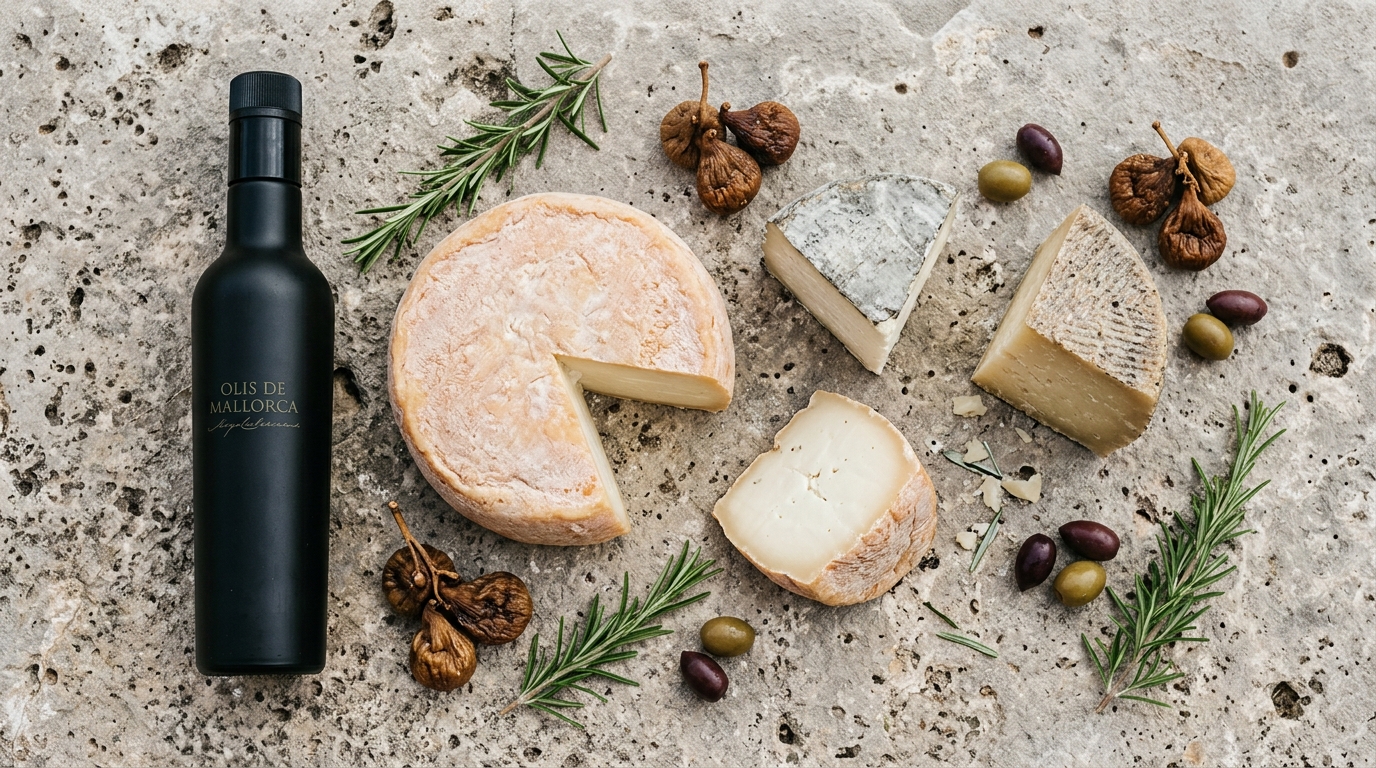
Finca Treurer’s extra virgin olive oil is an EVOO of the arbequina variety with the “Oli de Mallorca” designation of origin. Harvested at the veraison stage, the result is a moderately bitter and pungent oil, useful in any culinary preparation. Its most appreciated notes are banana and ripe apple, with olfactory reminiscences of fresh artichoke, nuts such as almond and even aromatic herbs.
That fruity profile and moderate bitterness make it an extraordinary companion for the island’s artisan cheeses. The key to the cheese-oil pairing lies in seeking a balance between intensity and complementarity: a mild oil enhances a delicate artisan cheese without overpowering it; an oil with character stands up to the power of a cured one.
Pairing summary table: cheese × Treurer oil
| Artisan cheese | Curing stage | Treurer notes that stand out | Serving suggestion |
|---|---|---|---|
| Fresh cow’s cheese | Fresh (0–7 days) | Ripe apple, almond, herbal freshness | Generous drizzle, flaked salt and fresh thyme |
| Semi-cured Mallorcan red sheep cheese | Semi-cured (~40 days) | Banana, artichoke, gentle bitterness | At room temperature, oil added just before serving |
| Cured Mallorcan red sheep cheese | Cured (5+ months) | Moderate bitterness and pungency, nuts | Thin wedge, a few drops of oil and Mallorcan honey |
| Semi-cured goat cheese | Semi-cured (~30–45 days) | Herbal freshness, citrus notes of the oil | With toasted payés bread and ramellet tomato |
Fresh cow’s cheese with Treurer
Fresh cheese, with its creamy texture and clean milky flavour, is the perfect canvas for a fruity EVOO. A generous drizzle of Treurer oil over a portion of fresh artisan cheese, accompanied by a pinch of flaked salt and fresh thyme, is one of the simplest and most elegant appetisers you can prepare. The almond and apple notes of the oil blend with the gentle acidity of the cheese, creating a clean and very Mediterranean harmony.
Semi-cured sheep cheese with Treurer
The semi-cured Mallorcan red sheep cheese, with its firm texture and more pronounced flavour, calls for an oil with some body. An EVOO with softness and delicate fruity aromas harmonises perfectly with an artisan sheep cheese, and Treurer fulfils exactly that role. Serve the cheese at room temperature — never straight from the fridge — and drizzle with the oil just before eating. The result is a cheese-oil pairing experience that sums up the gastronomic soul of Mallorca in a single bite.
Cured sheep cheese with Treurer
The cured stage is where artisan cheeses show their full complexity. An oil with fruity notes and bitter nuances combines perfectly with a cured cheese, as the intensity and persistence of the cured find a counterpoint in those nuances of the oil. Treurer’s slight pungency — characteristic of the veraison harvest — acts as a counterpoint to the fatty and saline profile of the cured, cleansing the palate between bites.
A simple recipe: cured cheese toast with Treurer oil and Mallorcan honey
Beyond pure tasting, Mallorcan artisan cheeses have a natural place in everyday cooking. This toast is perhaps the most direct way to understand the cheese-oil pairing in a real culinary context: few ingredients, all of the highest quality, extraordinary result.
Ingredients (for 2 people)
- 4 slices of payés bread or sourdough bread, lightly toasted
- 100 g of cured Mallorcan red sheep cheese, in thin slices
- 3–4 tablespoons of Treurer extra virgin olive oil
- 1 tablespoon of Mallorcan honey (preferably rosemary or wildflower)
- Flaked salt and freshly ground black pepper
- A few sprigs of fresh thyme (optional)
Method
- Toast the bread until it is crispy on the outside but tender on the inside. If you have a good Mallorcan payés bread, the result improves noticeably.
- Place the slices of artisan cured cheese on the still-warm toast, so that the heat slightly softens the paste without melting it completely.
- Drizzle generously with Treurer oil: do not skimp on the oil, as it is the element that unites all the flavours and provides the unctuousness that balances the saltiness of the cured cheese.
- Add a thin thread of honey on top. The sweetness of Mallorcan honey counteracts the moderate bitterness of the oil and enhances the nutty nuances of the cured cheese.
- Finish with flaked salt, black pepper and fresh thyme if using. Serve immediately.
This toast works as an appetiser, a light first course or as a close to an artisan cheese board. The combination of textures — crunch of the bread, creaminess of the softened cheese, liquid of the oil — and of flavours — salty, bitter, sweet, herbal — is a miniature summary of what the Mallorcan pantry can offer.
A gastronomic experience worth living on the island
Mallorca’s artisan cheeses are not a niche product: they are part of the island’s gastronomic heritage, with a history as long as that of olive oil itself. Getting to know them, by visiting dairies and local markets, is a way of understanding Mallorca beyond its beaches.
When you combine those Mallorcan artisan cheeses with a locally produced extra virgin olive oil such as Finca Treurer’s, the result transcends simple tasting. Two products from the same land, made with the same respect for the raw material, that enhance each other on the plate. That is, in essence, what it means to eat well in Mallorca.
If you have the opportunity to visit the estate in Algaida, do not hesitate to ask about the tasting experiences: Mallorca’s olive oil has been food for farmers and nobles alike, accompanying any dish and delighting palates from the simplest to the most complex recipes of traditional Mediterranean cuisine. Add a good artisan cheese to that equation and you will have one of the most authentic experiences the island can offer you.
Frequently asked questions
What is the most typical cheese from Mallorca?
Mallorcan red sheep cheese is considered the most representative of the island. It is made artisanally from the milk of a native breed, between November and May, using vegetable rennet. Its flavour varies according to the curing: from soft and creamy when fresh to powerful and persistent when cured.
Where can I buy artisan cheeses in Mallorca?
The best places are the local markets and gastronomic fairs spread across the island. You can also visit dairies directly, such as Son Jover (Inca), Formatges Burguera or Es Cabàs. Many of them sell in their own shops and in some cases offer visits to the dairy.
How do you correctly pair cheese and extra virgin olive oil?
The basic rule is to balance intensities: a fresh or mild cheese calls for a fruity and delicate oil; a semi-cured can handle an oil with a little more body; a powerful cured needs an oil with moderate bitterness and pungency that cleanses the palate. Treurer oil, an early-harvest arbequina, works well with all three stages thanks to its balanced profile.
Do Mallorca’s artisan cheeses have a designation of origin?
Unlike Mahón-Menorca cheese, which does have a PDO, Mallorca’s artisan cheeses do not have their own protected designation of origin. However, many artisan producers work with quality certifications and participate in international competitions such as the World Cheese Awards, where they have received recognition.