Solar eclipse on August 12, 2026: a unique experience from Mallorca

On August 12, 2026, Mallorca will experience one of the most extraordinary astronomical phenomena of the century: a total solar eclipse that will be fully visible from the island. It will be a unique event for residents and visitors alike, both because of the spectacular nature of the event and the privileged conditions in which it can be viewed: at sunset, with the sun very low on the horizon, in the middle of summer and with predictably clear skies.

The experience will not be partial or symbolic: the sun will be completely hidden behind the dark silhouette of the moon, plunging the island into an unexpected twilight for just over a minute, with unforgettable changes in light, temperature, and atmosphere. Those who are in open, well-oriented places—such as Puig de Randa, the west coast, or inland estates such as Treurer—will have the opportunity to experience it in all its intensity.

But to fully enjoy the eclipse, it is not enough to look at the sky: it is important to understand what is happening, how to observe it safely, and why this phenomenon is so exceptional in Europe and in the recent history of Spain.

What exactly will happen on August 12, 2026: a guide for non-astronomers

A total solar eclipse occurs when the Moon comes between the Earth and the Sun, casting its shadow over a very specific strip of the Earth’s surface. If you happen to be within that strip at that moment—as will be the case in Mallorca on August 12, 2026—you will see the solar disk disappear completely for a few minutes, plunging the world into darkness in the middle of the day.

Although solar eclipses occur relatively frequently around the world, only a small part of the planet can see them each time, and total eclipses from the same location are extremely rare. That is why experiencing a total eclipse without having to travel thousands of miles, and in favorable weather and landscape conditions, is an extraordinary opportunity.

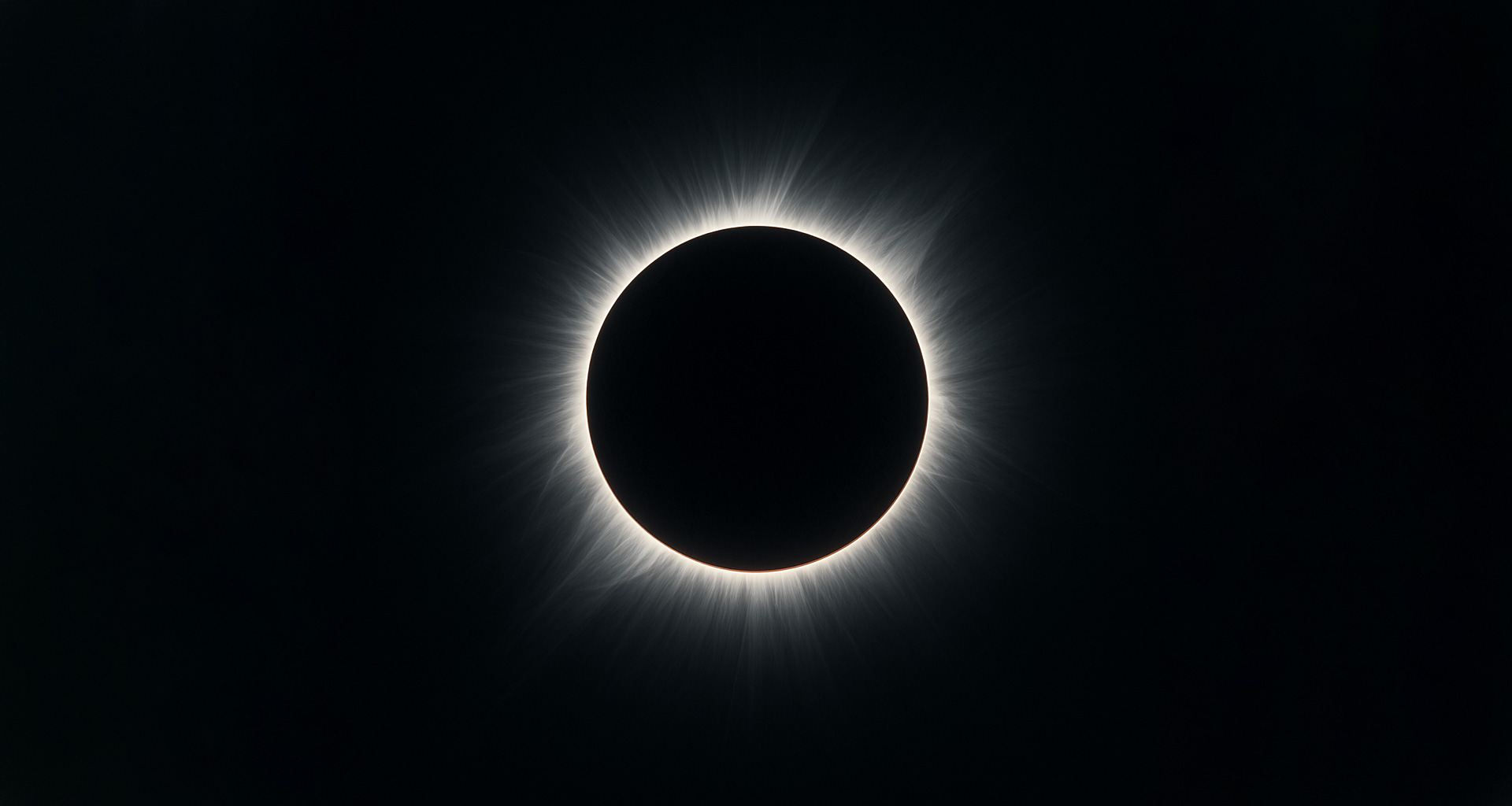
In the initial stages, the eclipse appears as a progressive bite on the edge of the sun. As it progresses, the light around you changes: the sky cools, the colors of the landscape fade, the temperature may drop, and nature reacts as if twilight were falling. Then, for just over a minute, the sun disappears completely and the solar corona becomes visible: a white, diffuse halo that extends around the black disk of the moon. This is the only moment when it can be viewed without protection (and with precautions).

After that central moment, the light returns in reverse, and the excitement of the phenomenon gives way to wonder and reflection. Many describe it as one of the most awe-inspiring experiences that can be had in the open air.

Path of the 2026 solar eclipse in Spain

Summary of practical information

ConceptDetails for Mallorca (Algaida / Puig de Randa area)
DateWednesday, August 12, 2026
Start of partial phase7:38 p.m.
Start of total phase8:31 p.m.
Duration of total eclipse1 minute and 36 seconds
End of eclipse (partial phase)8:42 p.m.
Sunset time8:49 p.m.
Best directions for viewingTowards the west and northwest, open horizon with no obstacles
Eye safety recommendationsMandatory use of approved eclipse glasses (ISO 12312-2); never look directly at the sun without protection
Suggested locationsPuig de Randa, Formentor, Es Trenc, Mirador de Banyalbufar, Finca Treurer (Algaida)

Why this solar eclipse is so special

The solar eclipse on August 12, 2026, is not only an impressive astronomical phenomenon: it is also an exceptional occasion due to its rarity, both on a European scale and for those in Mallorca.

A total eclipse in the middle of the European summer

Total eclipses visible from continental Europe are extremely rare. In recent decades, most eclipses have been partial or only visible from remote areas of the planet. The fact that this eclipse will occur in August, with stable weather and Mediterranean light, means that millions of people will be able to observe it without traveling long distances or worrying about adverse weather conditions.

When was the last total eclipse visible in Spain?

– The last total eclipse in Spain occurred on August 11, 1999, but the path of totality did not pass through Mallorca, and it was only visible from the northeast of the peninsula.

– In Mallorca, the closest thing was the annular eclipse on October 3, 2005, but there was no total occultation.

– Therefore, the eclipse of 2026 will be the first total eclipse visible from Mallorca in over a century.

And when will the next one be?

– The next total eclipse visible anywhere in Spain will be in August 2027, but the path of totality will pass through the south of the peninsula (Cadiz and eastern Andalusia), not the Balearic Islands.

– The next total eclipse visible in Mallorca is expected in the year 2666, according to current calculations.

– In Western Europe, another total eclipse comparable in accessibility is not expected until the year 2081.

Solar Eclipse

Coincidencia con el atardecer

Además, este eclipse tiene una característica estética única: la totalidad ocurrirá con el sol casi tocando el horizonte, justo antes de ponerse. Esto amplifica la belleza del fenómeno, tiñendo el cielo de tonos rojos, dorados y malva, y creando un espectáculo visual inigualable.

Ver un eclipse total al atardecer, desde una isla mediterránea, sin contaminación lumínica y con todo el horizonte abierto, es una oportunidad que solo se presenta una vez en la vida.

How the solar eclipse will be seen from Mallorca

Mallorca is located entirely within the path of totality, which means that the eclipse on August 12, 2026 will be visible as total from virtually anywhere on the island. Without the need for advanced equipment or complex travel arrangements, it will be possible to see how the sun is completely hidden by the moon, creating a brief moment of darkness at sunset.

Approximate times for Algaida and the center of the island (local time – CEST):

  • Start of the partial eclipse: 7:38 p.m.
  • Start of totality: 8:31 p.m.
  • Maximum eclipse: 8:32 p.m.
  • End of totality: 8:33 p.m.
  • Sunset (already partially eclipsed): 8:42 p.m.

What exactly will we see?

During the partial phase, the silhouette of the Moon will gradually cover the solar disk.

– The atmosphere will darken, the colors of the landscape will become cold and diffuse, and the temperature may drop slightly.

During totality (just over a minute), the Sun will disappear completely: the sky will darken as if in a brief twilight, the solar corona will be visible, and, if the horizon is clear, even some planets or stars.

Afterwards, the light will return quickly, and the Sun will set partially eclipsed on the western horizon.

Will it be a total solar eclipse in other European countries?

Only certain places on the European continent will be able to see the eclipse on August 12, 2026 as total, and among them, Spain occupies an absolutely privileged position.

Where will it be visible as a total eclipse?

The eclipse will only be total in:

  • Northern Spain: including Galicia, Asturias, Castile and León, the Basque Country, Navarre, Aragon, northern Castile-La Mancha, and the Balearic Islands (including Mallorca).
  • The western tip of Iceland
  • Greenland
  • The northern tip of Siberia (Arctic Russia)

Outside these areas, the eclipse will be partial.
“2026
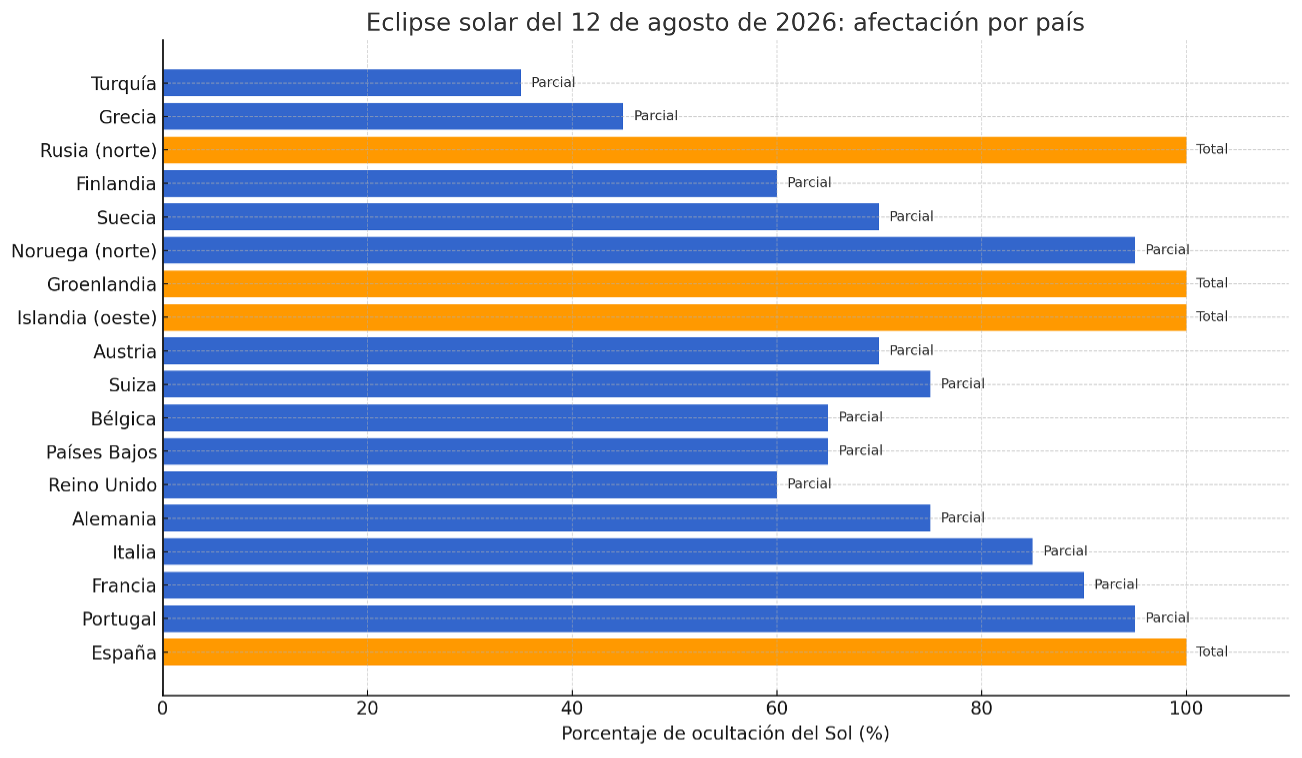
2026 solar eclipse by country

And in the rest of Europe?

In countries such as France, Italy, Switzerland, Germany, the United Kingdom, the Netherlands, Belgium, and Scandinavia, the eclipse will only be visible partially, with the percentage of coverage decreasing the further away you are from the path of totality. In most of central Europe, the Sun will appear partially covered by the Moon, but it will not be completely obscured.

CountryType of eclipsePercentage of occultation (approx.)Geographical notes
SpainTotal100% in the north of the peninsula and the Balearic IslandsMost of the northern half of Spain in the totality zone
PortugalPartial70%–95%Maximum in the northeast; not in the totality zone
FrancePartial70%–90%Eclipse highly visible in the south and center
ItalyPartial60%–85%Greater visibility in the north (Tuscany, Emilia-Romagna)
GermanyPartial40%–75%Coverage decreases from south to north
United KingdomPartial30%–60%Visible throughout the country, but with low coverage
NetherlandsPartial40%–65%Eclipse visible, without total phase
BelgiumPartial45%–65%Well-defined partial eclipse at sunset
SwitzerlandPartial60%–75%Greater coverage in the south of the country
AustriaPartial50%–70%No total phase
Iceland (west)Total100%Only in the far west
GreenlandTotal100%Total eclipse over most of the territory
Norway (north)Partial / very highUp to 95%Not in the total path, but significant obscuring in the north
SwedenPartial50%–70%Best visibility in the south
FinlandPartial40%–60%Eclipse visible but without total phase
Russia (north)Total100%Only in areas of the Arctic and extreme Siberia
GreecePartial20%–45%Low occultation, visible in the west
TurkeyPartial10%–35%Weak eclipse low on the western horizon

Note: Percentages and areas are approximate and refer to the estimated maximum occultation of the solar disk on August 12, 2026, according to visibility maps from NASA, TimeAndDate, and Wikipedia.

An exceptional opportunity from Spain

What makes this eclipse particularly significant is that:

  • Most of its total phase visible on land occurs in Spanish territory.
  • In places such as Mallorca, the entire eclipse will be visible just before sunset, with the Sun setting eclipsed on the horizon.
  • This makes it one of the most spectacular and accessible eclipses of the century for those in Spain.

2026 solar eclipse by region in Spain

2026 solar eclipse by region in Spain
What do I need to safely observe the eclipse?

Watching a solar eclipse can be an unforgettable experience, but it is essential to do so with adequate protection. Even during a partial eclipse or in the phases before and after totality, looking directly at the Sun can seriously damage the retina in a matter of seconds.

Here’s what you need to enjoy it safely:

  • Special solar eclipse glasses: these must comply with the ISO 12312-2 standard. Conventional sunglasses or homemade filters are not suitable.
  • Approved solar filters for telescopes or cameras, if you want to observe or photograph the phenomenon with optical instruments.
  • Avoid dangerous improvisations, such as X-rays, smoked glass, or photographic negatives.
  • During the exact moment of totality (when the Sun is completely hidden), you can look directly at it without protection, but only if you are within the total eclipse path and only during that brief period. In Mallorca, it will last just over a minute and a half.

Additional recommendation: if you plan to photograph it, prepare your equipment in advance and carry out preliminary tests. The eclipse progresses quickly, and key moments cannot be repeated. Use a tripod, timer, or remote shutter release, and don’t forget to protect the camera sensor with a suitable filter.

A combination of caution and planning will make this astronomical experience as exciting as it is safe.

Where to watch the 2026 solar eclipse: the best spots on the island of Mallorca

To watch the eclipse on August 12, 2026, in Mallorca, it is best to find an elevated spot with a clear view of the western horizon, as the phenomenon will take place at sunset, with the Sun getting lower and lower. Here are some of the most recommended spots:

  • Puig de Randa: a central location on the island, with unobstructed views in all directions. Its altitude and isolation make it one of the best options in terms of accessibility and quality of vision. Finca Treurer, located nearby, is an ideal alternative for enjoying the eclipse away from any source of light or visual pollution.
  • Cabo de Formentor: the northern tip of the island offers breathtaking views of the sea and sky, although access in August may be restricted. It is advisable to plan ahead.
  • Es Trenc Beach: wide, open, and favorably oriented. If the weather conditions are right, it allows direct observation of the eclipse reflecting on the sea.
  • Banyalbufar or Son Marroig viewpoints: spectacular for watching sunsets, they also offer favorable conditions for following the eclipse’s progress over the western coast.

Practical tips:

  • Arrive early enough to find a good spot without rushing.
  • Bring water, sunscreen, and light clothing, but also something warm if you are going to higher areas.
  • Avoid crowded urban or coastal areas, as the influx of visitors can make access and the experience difficult.
  • Remember that in high, dark areas, such as the surroundings of Treurer, you will be able to better appreciate the contrast of light and the sudden decrease in brightness during totality.

Watching the eclipse from one of these privileged spots will not only be an astronomical event, but also an intimate experience with nature and the Mallorcan landscape.

Other articles that might interest you

Mllorca en Octubre, Fiesta en Porreres
Mallorca in October

We tell you everything about Mallorca in October: temperatures, plans and activities, where to stay and gastronomy.

Last published articles

Cuevas del Drach, Mallorca
Caves of Drach

Delve into the Caves of Drach in Mallorca: an underground world with spectacular formations, the illuminated Lake Martel, and an unforgettable live concert underground.

Mallorca en julio, Festes del Carme, Port d'Andratx
Mallorca in July

Mallorca in July means sun, warm sea, and nights of partying. Experience the maritime processions, savor summer fruits, and discover unique experiences in the heart of the Mediterranean season.

Monasterio de Lluc, Mallorca, vista aérea
Monasteries on the island of Mallorca

Discover the monasteries of Randa—Cura, San Honorato, and Gracia—and other sanctuaries in Mallorca. A spiritual journey through nature, earth energy, and silence.

0
    0
    Your Cart
    Your cart is emptyReturn to Shop
    Reserve the 2025 vintage now

    Due to low EVOO production in the 2024 harvest due to weather conditions, we have been forced to close sales until the new harvest in October. Reserve your EVOO from the 2025 harvest now.

    Treurer Circle

    If you’re part of our circle of friends you will have lots of benefits.
    You can be part of it from the first purchase.

    Advantage

    Being a member of the Treurer Club will give you access to the exclusive sale of "novell oil" during the month of November.

    Are you planning to travel to Mallorca? We would like to meet you! Come visit us and make the complete tour around our farm at no cost (free admission for 2 adults, prior booking required).

    Membership requirements

    You can belong to our circle, by meeting two simple conditions:

    Have purchased at least two boxes of product in the last 12 months.

    Be registered in our newsletter.