


Have you ever drizzled oil over toasted bread and felt there was something more behind that flavour? Olive oil tasting is the discipline that turns that intuition into knowledge. You don’t need to be a professional taster to get started: you just need to know what to look for, how to prepare your senses and understand the language used to describe a good EVOO. This guide walks you through the entire olive oil tasting process, from the basic equipment to how to read the label before buying.
Article contents
- What olive oil tasting really is and why it is worth learning
- The essential equipment before you begin
- The three phases of sensory tasting
- How to identify the most common defects
- Comparative table of varieties: arbequina, picual and hojiblanca
- The sensory profile of Mallorcan arbequina olive oil
- How to read an EVOO label
- Storing EVOO: temperature, light and time
- How to do your first tasting at home step by step
- Basic sensory glossary
- Olive oil tasting as a cultural experience in Mallorca
Contenidos / Contents
- What olive oil tasting really is and why it is worth learning
- The essential equipment before you begin
- The three phases of sensory tasting
- How to identify the most common defects
- Comparative table of varieties: arbequina, picual and hojiblanca
- The sensory profile of Mallorcan arbequina olive oil
- How to read an EVOO label
- Storing EVOO: temperature, light and time
- How to do your first tasting at home step by step
- Basic sensory glossary
- Olive oil tasting as a cultural experience in Mallorca
- Frequently asked questions about olive oil tasting
- Sources
Contenidos / Contents
What olive oil tasting really is and why it is worth learning
Olive oil tasting is much more than a gourmet exercise. Sensory analysis is a technique used to evaluate the sensory characteristics of a product. In the case of extra virgin olive oil, that evaluation has practical consequences: olive oil tasting is regulated and virgin and extra virgin olive oil must pass a mandatory organoleptic check under European regulations. The organoleptic assessment of virgin olive oil forms part of the official control that Member States of the European Union must carry out, in accordance with the provisions of Regulation (EC) No 882/2004 of the European Parliament and of the Council, and this assessment is carried out by a panel of qualified tasters, in accordance with the method described in Annex XII of Commission Regulation (EEC) No 2568/91, which in turn is based on the method of the International Olive Council (IOC). All virgin oils on the market must have previously been tasted by that trained panel.
In other words: every bottle of EVOO you buy has already passed through this filter. Learning to taste olive oil is not an elitist whim, but rather reclaiming the criterion that the system already uses to guarantee what you bring to your table. And if you are lucky enough to be in Mallorca and visit an estate like Finca Treurer, olive oil tasting becomes something more: a direct window into the territory, the variety and the philosophy behind each harvest.
The essential equipment before you begin
A well-conducted olive oil tasting requires very little equipment, but that little matters. Before beginning any olive oil tasting session, it is necessary to prepare the specific materials that ensure a precise sensory evaluation; tasting glasses are glass vessels specially designed for olive oil tasting, whose shape helps concentrate the aromas and allows a better appreciation of the oil’s notes both on the nose and in the mouth.
The “watch glass” is the round glass lid placed over the tasting glass during olive oil tasting; it serves to retain the aromas inside, favouring their condensation, and when removed, these are released intensely, facilitating the olfactory analysis. The equipment is completed by an evaluation sheet on which to note the impressions of each sample: aroma, flavour, texture and possible defects.
At home, you can substitute the standardised glass with a small dark or blue glass, which prevents you from seeing the colour and eliminates that visual bias. What has no substitute is concentration: it is necessary not to smoke, not to drink coffee and not to eat for one hour before carrying out the olive oil tasting. The body is the instrument; it must be tuned before playing.
The three phases of sensory tasting
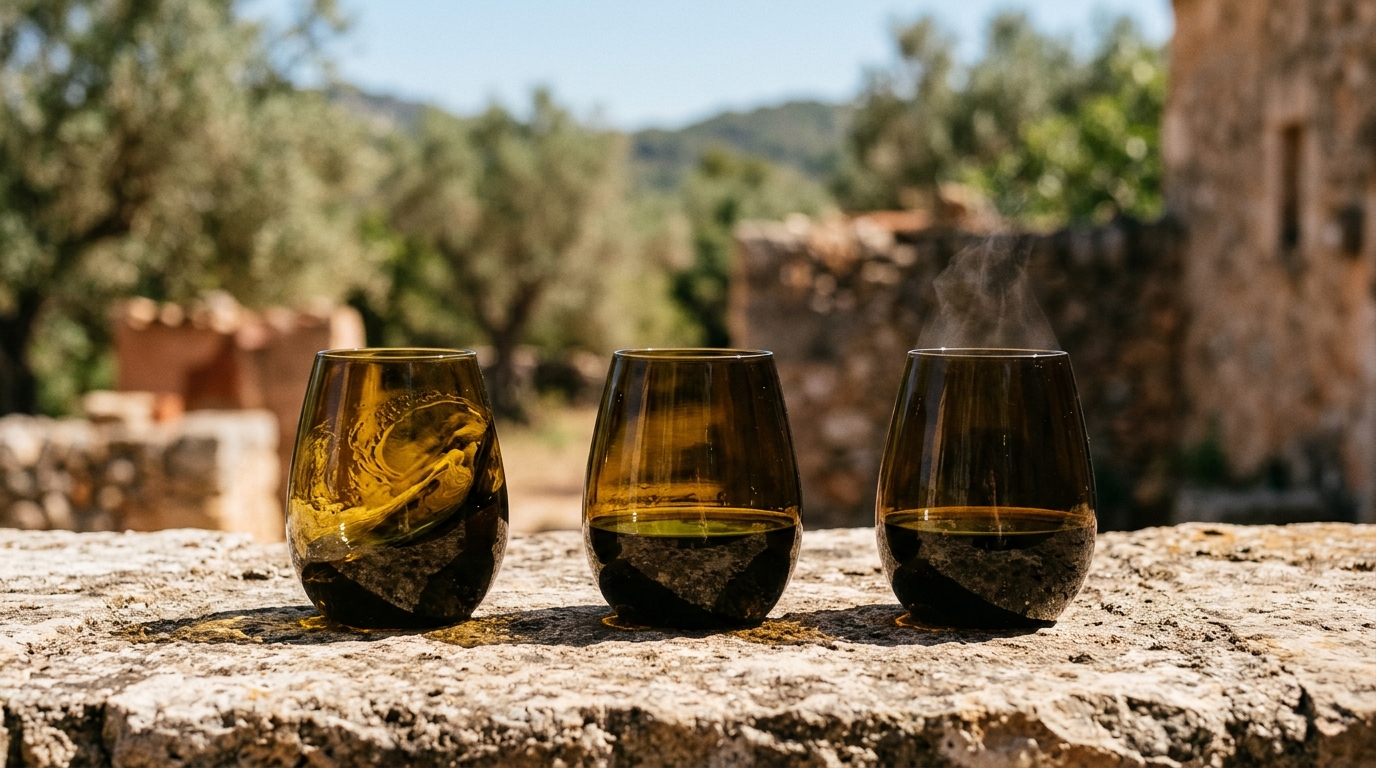
The sensory tasting of an extra virgin olive oil always follows the same order: sight, smell and taste. Each phase provides different information and, together, they build the complete portrait of the oil. Knowing these phases is the first step towards conducting an olive oil tasting with discernment.
Visual phase: colour as a first clue
The colour can range from a golden yellow, which characterises a riper and sweeter oil, to an intense green that characterises more herbaceous and bitter oils. In olive oil tasting, the glass is held at eye level to evaluate the brightness, density and colour of the oil. A clean and bright oil is a positive sign; turbidity may indicate that the filtration process has not been completed or that the oil has aged poorly.
That said, it is worth remembering that a professional taster should not take this phase into account when evaluating the quality of the oil —hence the dark glass cups used in official olive oil tastings—. For a beginner, the visual phase serves as an introduction to the character of the oil, not as a verdict.
Olfactory phase: where the aromatic notes live
This is the most revealing phase of any olive oil tasting. To taste olive oil in the olfactory phase, we must pour about three tablespoons of oil into the glass and cover it with the watch glass; oil is less aromatic than wine, so we must warm it for tasting. The warmth of the hands —between 27 and 30 °C— activates the volatile compounds and releases the aromatic notes that define the personality of the oil.
What can you find in an olive oil tasting? The most common references in a quality EVOO are: freshly cut grass, green tomato, almond, apple, artichoke or banana. In Finca Treurer’s oil, made with arbequina olives from Mallorca, the aromatic profile tends towards soft notes of almond and ripe fruit, with a vegetal freshness characteristic of early harvesting. Those aromatic notes are the signature of the territory and the variety.
Gustatory phase: the balance of the three attributes
Through a series of short, repeated inhalations, the intensity and gustatory structure are evaluated during olive oil tasting. In the mouth, an EVOO is judged by three fundamental positive attributes: fruitiness, bitterness and pungency. A good oil must show a clear balance between these three positive attributes of virgin olive oil.
“Bitterness” is the most important flavour in olive oil tasting; it is detected by the taste buds located at the back of the tongue. The tactile sensation of pungency is characteristic of olive oils, but becomes more prominent in oils obtained at the beginning of the season, mainly from still-green olives. Far from being defects, bitterness and pungency are signs of richness in polyphenols: the more intense they are, the greater the antioxidant potential.
How to identify the most common defects
Learning to taste a good oil is half the journey. The other half is recognising when something is wrong. In olive oil tasting oriented towards quality control, the objective is the detection of attributes and possible defects to determine whether a batch of oil is extra virgin or not. For a beginner, it is enough to know the three most frequent defects.
- Fusty/muddy sediment: a fermentation smell, similar to olives in poor condition. It indicates that the fruit was stored for too long before milling.
- Rancid: the most recognisable defect in any olive oil tasting. That smell of old fat or crayon is a sign of irreversible oxidation due to exposure to air, light or heat.
- Winey/vinegary: reminiscent of vinegar or rough wine. It appears when the olives have fermented anaerobically before pressing.
If you detect any of these aromas during olive oil tasting, the oil cannot be classified as extra virgin, regardless of what the label says. The sense of smell does not lie: it is the first quality filter available to you. In fact, for an oil to be labelled as Extra Virgin it must meet, among other criteria, the complete absence of sensory defects according to the official tasting panel.
Comparative table of varieties: arbequina, picual and hojiblanca
Not all extra virgin olive oils taste the same, and that is precisely what makes olive oil tasting so fascinating. The olive variety is the factor that most determines the sensory profile of an EVOO. The three most common varieties on the Spanish market are Picual, Arbequina and Hojiblanca, each with its own character that makes it ideal for different uses. Knowing them in advance sharpens perception before the oil reaches the glass.
| Variety | Intensity | Typical aromatic notes | Recommended culinary use |
|---|---|---|---|
| Arbequina | Mild / medium | Almond, banana, apple, ripe fruit | Salads, desserts, steamed fish, delicate dressings |
| Picual | High | Freshly cut grass, green tomato, fig tree | Frying, grilled meats, bread with tomato, gazpacho |
| Hojiblanca | Medium | Ripe tomato, almond, sweet and slightly pungent notes | Roasted vegetables, pulses, sauces, versatile raw use |
Arbequina is characterised by its smoothness, fruity flavour and sweetness, making it perfect for those seeking a delicate and harmonious oil. Picual stands out for its intensity, bitterness and fresh grass aroma, ideal for those who prefer a more powerful flavour. Hojiblanca is distinguished by its balance between bitter and pungent, with notes of tomato and almond. A comparative olive oil tasting between these three varieties is, without doubt, the most revealing exercise for a beginner; conducting a side-by-side oil tasting with all three immediately makes it clear how the variety shapes the sensory profile.
The sensory profile of Mallorcan arbequina olive oil
The variety, the soil, the climate and the moment of harvesting configure a unique sensory profile for each origin. The combination of native varieties, specific climatic conditions —altitude, Mediterranean humidity, calcareous soils— and early harvesting techniques gives Mallorcan oil a smooth profile, with notes of almond and fresh grass, that distinguishes it from the more intense oils of the southern Iberian Peninsula. An olive oil tasting of Mallorcan origin alongside an Andalusian or Extremaduran one immediately highlights these differences.
Finca Treurer works exclusively with the arbequina variety grown in Algaida, in the heart of Mallorca. It is an arbequina variety oil harvested at the veraison stage; the result is an EVOO that preserves the healthy benefits of the olive and is moderately bitter and pungent, making it versatile in any culinary preparation. The olive oil tasting of Finca Treurer reveals how Finca Treurer applies harvesting and production criteria that connect directly with the tradition of Mallorcan olive oil masters: respect for local varieties, early harvesting and minimal intervention during extraction.
The result is an oil of medium intensity, balanced, where fruitiness dominates without overwhelming the bitterness or pungency. An oil, in short, that lends itself to tasting: generous in nuances, without sharp edges to distract. In pairing, it fits especially well with seasonal salads, baked fish, fresh cheeses and Mallorcan pastries; its smoothness does not compete with the ingredients, but rather enhances them.
How to read an EVOO label
Olive oil tasting actually begins before opening the bottle. Knowing how to read the label is the bridge between learning to taste and knowing how to buy better. There are four pieces of information that should never be missing from a quality EVOO and that are worth looking for before reaching for your wallet.
- Harvest date or campaign: do not confuse this with the expiry date. The campaign indicates when the olives were harvested; an EVOO from a recent harvest —less than 18 months ago— better preserves its organoleptic properties and its richness in polyphenols. If the label only shows the best-before date, be wary.
- Maximum acidity: for an oil to be classified as extra virgin, its free acidity expressed in oleic acid must not exceed 0.8 grams per 100 grams. A low acidity —below 0.3%— usually indicates excellent raw material and a careful extraction process, although this figure alone does not guarantee sensory quality.
- PDO / PGI: Protected Designations of Origin and Protected Geographical Indications guarantee that the oil comes from a specific geographical area and meets an audited set of conditions. Not all great EVOOs have a PDO, but its presence is a sign of traceability.
- Filtered or unfiltered: an unfiltered oil may show turbidity and natural sediment; this is not a defect, but its shelf life is shorter. A filtered oil is more stable and easier to store at home. The choice depends on the intended use and how quickly you consume it.
If the label lacks a harvest date, the acidity does not appear or the category designation is ambiguous, price is not a sufficient guarantee. A quick olive oil tasting at home remains the most reliable criterion.
Storing EVOO: temperature, light and time
An extra virgin olive oil can be exceptional at the time of harvest and arrive at your table in mediocre condition if it has not been stored properly. The degradation of EVOO is silent: it does not change colour noticeably or give off obvious signs until rancidity has already set in. Three factors accelerate that deterioration and it is worth controlling them from the very first day.
- Temperature: the ideal is to store oil between 14 and 18 °C, away from heat sources such as the hob or oven. Heat not only oxidises fatty acids: it destroys the polyphenols that make EVOO healthy. Never store oil next to the cooker.
- Light: ultraviolet light is the silent enemy. That is why the best oils are packaged in dark glass or opaque tins. If you buy in clear glass, keep the bottle in a closed cupboard; the worktop, however attractive it looks, is not the best place.
- Time after opening: once opened, a quality EVOO maintains its optimal organoleptic properties for four to six weeks if kept well sealed and away from heat and light. After that time, the oil is still suitable for cooking, but loses nuances when used raw. The practical rule is simple: buy in formats you can consume within a month.
Oil should not be frozen or refrigerated: cold causes reversible crystallisation, but alters the texture and can generate condensation when returning to room temperature, which accelerates oxidation. A cool, dark pantry remains the best option. A poorly stored oil will arrive in poor condition at any olive oil tasting, however good its original quality.
How to do your first tasting at home step by step
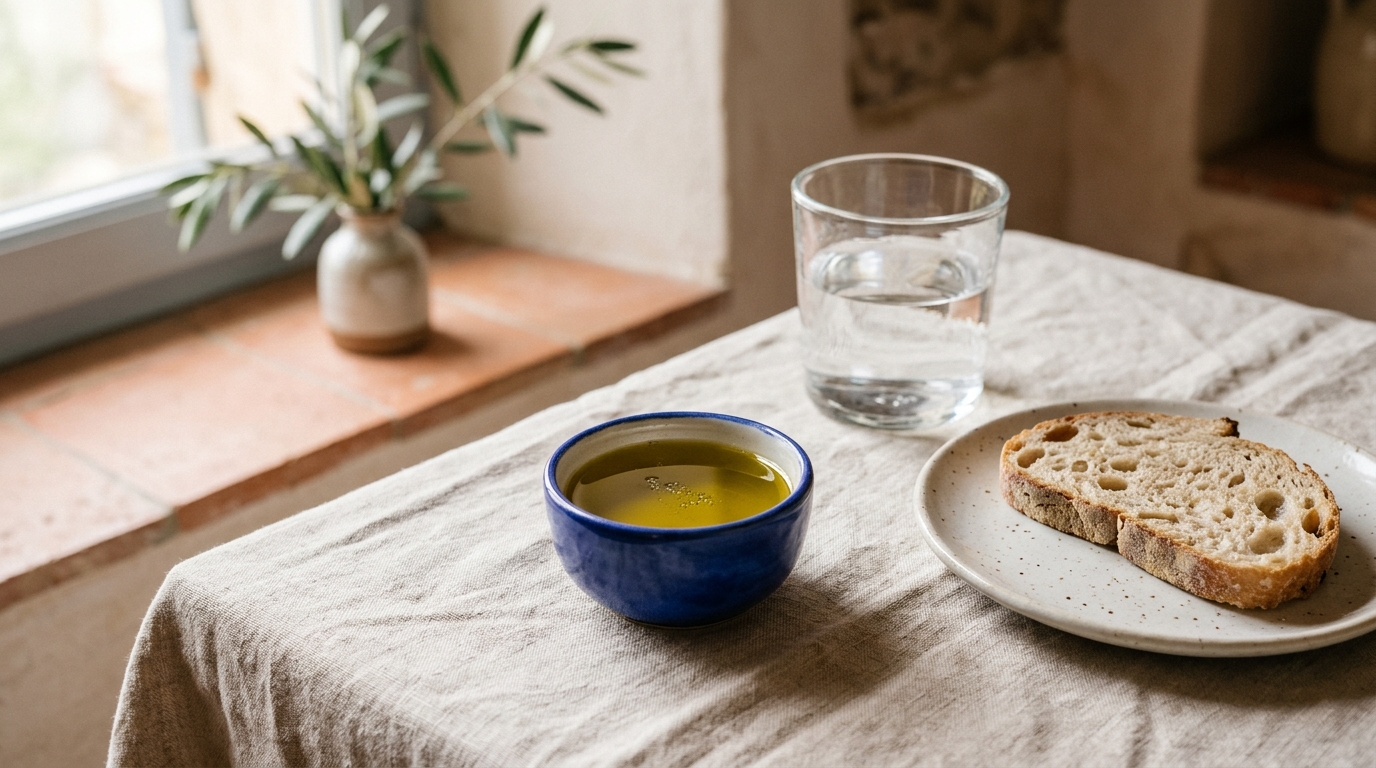
Theory is all well and good, but olive oil tasting is learned by tasting. Here is a simple protocol for your first olive oil tasting session at home, without professional equipment.
- Choose two or three different oils. Comparison is the best teacher in any olive oil tasting. Look for at least one early-harvest oil (green, intense) and one riper one (golden, smooth).
- Prepare the glasses. Small, glass ones, with about 15–20 ml of oil each. Cover with cling film or a coaster.
- Warm the glass between your hands for one minute, with the oil covered. This activates the volatile aromas.
- Uncover and smell slowly. Take ten seconds. What does it remind you of? Write down the first word that comes to mind: it is the most honest one.
- Take a small sip into your mouth and spread it across the whole tongue. Inhale a little air between your teeth —the “slurp”— to volatilise the retronasal aromas.
- Evaluate the finish. How long does the pungency last? Does the bitterness appear at the beginning or at the end? Persistence in the mouth is an indicator of quality in olive oil tasting.
Between samples, cleanse your palate with a piece of apple or lukewarm water. Bread, although traditional in many olive oil tastings, can mask nuances with its own flavour. Patience and concentration are your best allies.
Basic sensory glossary
Olive oil tasting has its own vocabulary. Knowing it in advance is not an academic exercise: it is what allows you to move from “I like it” to “I know why I like it”. These are the terms that appear most often in a sensory tasting and that are worth being clear about before you begin.
| Term | Practical definition |
|---|---|
| Green fruitiness | Aromas reminiscent of freshly harvested olives, grass, artichoke or green tomato. Typical of early harvests. |
| Ripe fruitiness | Sweeter and softer aromas: apple, banana, almond. Characteristic of olives harvested at full ripeness. |
| Retronasal | Aromas perceived from the mouth towards the nose when swallowing or inhaling. They complete the profile that direct nasal perception does not capture. |
| Persistence | The length of time flavours remain in the mouth after swallowing the oil. The greater the persistence, the greater the complexity and quality. |
| Oleocanthal | Polyphenol responsible for the pungency felt in the throat. It has documented anti-inflammatory properties; its intensity indicates antioxidant richness. |
| Positive attribute | A desirable quality in olive oil tasting: balanced fruitiness, bitterness and pungency. Their absence or imbalance may indicate a defect. |
| Defect / negative attribute | An undesirable sensation (rancid, winey, fusty) that prevents the oil from being classified as extra virgin by the official panel. |
Olive oil tasting as a cultural experience in Mallorca
Tasting olive oil in Mallorca is not the same as doing it at home. When olive oil tasting takes place in the very location where the oil is born, the senses sharpen in a way that is difficult to explain and easy to feel. Estates like Treurer offer a genuine immersion in the culture of extra virgin olive oil, with olive oil tasting experiences that go from harvest to glass, in a protected natural environment.
Lovers of fine gastronomy and those who make health their leitmotif will appreciate the immersive experience in the world of extra virgin olive oil; guests can learn about the care of the olive trees, the process of obtaining the juice at the mill, the bottling and how to recognise a quality oil through tasting. It is the kind of knowledge that permanently transforms one’s relationship with this ingredient.
At Finca Treurer, olive oil tasting forms part of a broader experience: that of understanding Mallorca through its agricultural roots, through the centuries-old olive trees of Algaida and through a tradition that connects each bottle with the island’s agricultural memory. Whoever tastes Finca Treurer’s oil on the estate itself does not only learn to distinguish fruitiness from bitterness: they learn to read the landscape.
If you visit Mallorca and want to understand the diversity of local oil, look for tastings that include native varieties alongside non-native varieties grown on the island; the difference in profile is immediate and revealing. Comparative sensory tasting is, without doubt, the most pleasurable shortcut to understanding the territory.
Frequently asked questions about olive oil tasting
How many oils can be tasted in a single session?
The ideal for a beginner in olive oil tasting is not to exceed three or four samples per session. From the fourth onwards, the palate tires and the ability to discriminate between nuances decreases noticeably. If you want to taste more oils, divide the session into two blocks with a break of at least twenty minutes.
Does the colour of the oil indicate its quality?
Not directly. The colour depends on the variety, the degree of ripeness of the olive and the moment of harvest, but it is not a reliable indicator of quality in olive oil tasting. An intensely green oil can be exceptional or defective; the same applies to a golden one. That is why professional tasters use dark glass cups: to eliminate that bias and focus on the aroma and flavour.
Is the pungency in the throat a defect of the oil?
Quite the opposite. The pungency —especially that felt at the back of the throat during olive oil tasting— is a sign of a high content of oleocanthal, a polyphenol with anti-inflammatory properties. Early-harvest oils, such as that of Finca Treurer, tend to present this pungency with greater intensity precisely because of their richness in natural antioxidants.
What is the difference between a professional tasting and an amateur tasting?
Professional olive oil tasting follows a standardised protocol set by the International Olive Council, with trained panels, controlled conditions of temperature and light, and standardised evaluation sheets. Amateur olive oil tasting is freer: the objective is not to classify the oil according to regulations, but to develop personal discernment and enjoy the process. Both share the same phases —visual, olfactory and gustatory— and the same sensory vocabulary.
Can I do an olive oil tasting at Finca Treurer?
Yes. Finca Treurer, located in Algaida (Mallorca), offers guided olive oil tasting experiences as part of its agritourism offering. Visitors can learn about the complete EVOO production process —from the olive grove to the mill— and learn to identify the sensory attributes of Mallorcan arbequina oil in the very environment where it is born. An experience that combines learning, gastronomy and landscape in a way that is difficult to replicate.
How long does an opened EVOO last?
Once the bottle is opened, a quality extra virgin olive oil maintains its optimal organoleptic properties for four to six weeks if kept well sealed, away from heat and direct light. After that time it is still suitable for cooking, but loses some of its nuances when used raw. The best strategy is to buy in formats suited to the household’s monthly consumption.
Sources
{“@context”:”https://schema.org”,”@type”:”FAQPage”,”inLanguage”:”en”,”mainEntity”:[{“@type”:”Question”,”name”:”How many oils can be tasted in a single session?”,”acceptedAnswer”:{“@type”:”Answer”,”text”:”\u003Cp\u003EThe ideal for a beginner in olive oil tasting is not to exceed three or four samples per session. From the fourth onwards, the palate tires and the ability to discriminate between nuances decreases noticeably. If you want to taste more oils, divide the session into two blocks with a break of at least twenty minutes.\u003C/p\u003E”}},{“@type”:”Question”,”name”:”Does the colour of the oil indicate its quality?”,”acceptedAnswer”:{“@type”:”Answer”,”text”:”\u003Cp\u003ENot directly. The colour depends on the variety, the degree of ripeness of the olive and the moment of harvest, but it is not a reliable indicator of quality in olive oil tasting. An intensely green oil can be exceptional or defective; the same applies to a golden one. That is why professional tasters use dark glass cups: to eliminate that bias and focus on the aroma and flavour.\u003C/p\u003E”}},{“@type”:”Question”,”name”:”Is the pungency in the throat a defect of the oil?”,”acceptedAnswer”:{“@type”:”Answer”,”text”:”\u003Cp\u003EQuite the opposite. The pungency —especially that felt at the back of the throat during olive oil tasting— is a sign of a high content of oleocanthal, a polyphenol with anti-inflammatory properties. Early-harvest oils, such as that of Finca Treurer, tend to present this pungency with greater intensity precisely because of their richness in natural antioxidants.\u003C/p\u003E”}},{“@type”:”Question”,”name”:”What is the difference between a professional tasting and an amateur tasting?”,”acceptedAnswer”:{“@type”:”Answer”,”text”:”\u003Cp\u003EProfessional olive oil tasting follows a standardised protocol set by the International Olive Council, with trained panels, controlled conditions of temperature and light, and standardised evaluation sheets. Amateur olive oil tasting is freer: the objective is not to classify the oil according to regulations, but to develop personal discernment and enjoy the process. Both share the same phases —visual, olfactory and gustatory— and the same sensory vocabulary.\u003C/p\u003E”}},{“@type”:”Question”,”name”:”Can I do an olive oil tasting at Finca Treurer?”,”acceptedAnswer”:{“@type”:”Answer”,”text”:”\u003Cp\u003EYes. Finca Treurer, located in Algaida (Mallorca), offers guided olive oil tasting experiences as part of its agritourism offering. Visitors can learn about the complete EVOO production process —from the olive grove to the mill— and learn to identify the sensory attributes of Mallorcan arbequina oil in the very environment where it is born. An experience that combines learning, gastronomy and landscape in a way that is difficult to replicate.\u003C/p\u003E”}},{“@type”:”Question”,”name”:”How long does an opened EVOO last?”,”acceptedAnswer”:{“@type”:”Answer”,”text”:”\u003Cp\u003EOnce the bottle is opened, a quality extra virgin olive oil maintains its optimal organoleptic properties for four to six weeks if kept well sealed, away from heat and direct light. After that time it is still suitable for cooking, but loses some of its nuances when used raw. The best strategy is to buy in formats suited to the household’s monthly consumption.\u003C/p\u003E”}}]}


