


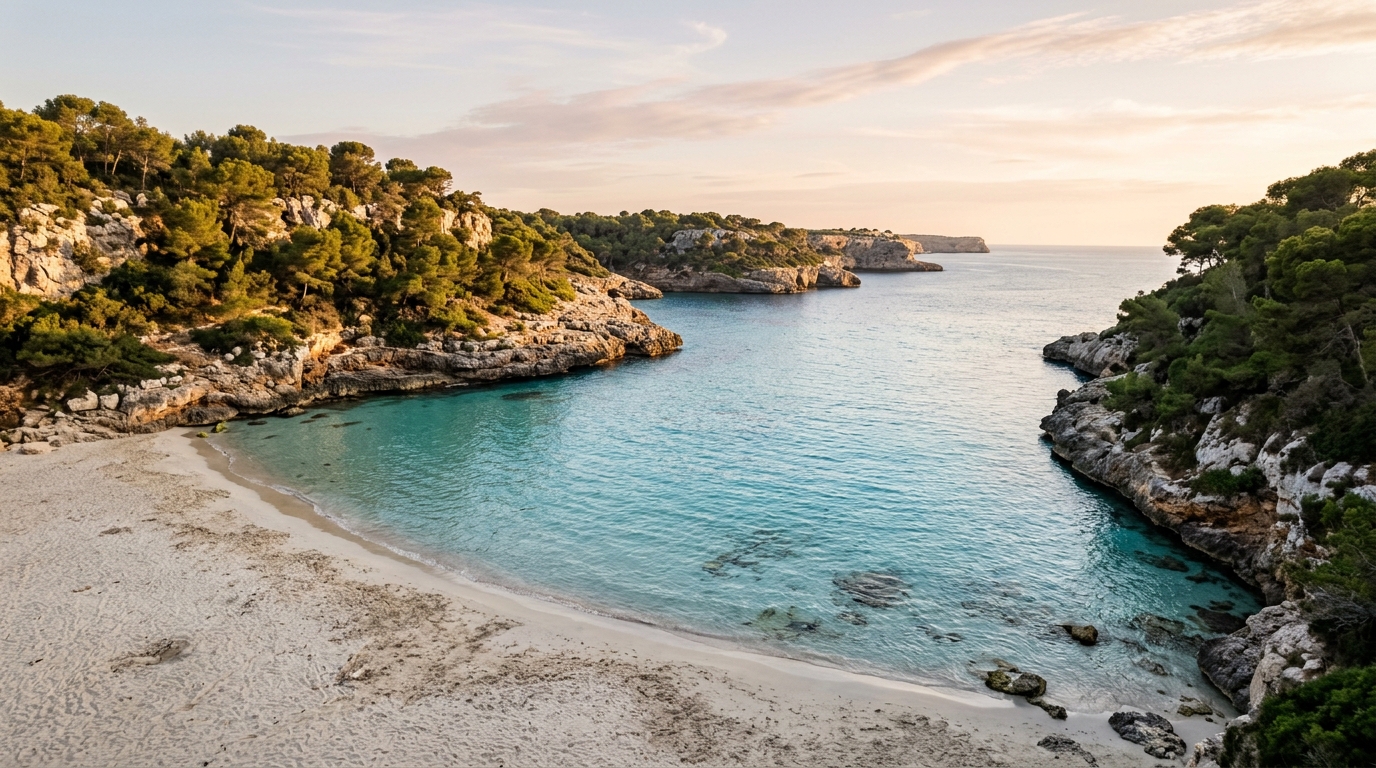
Are you looking for a beach that combines white sand, impossibly blue waters and the certainty that the landscape around you will be protected forever? Cala Mondragó is exactly that: an enclave in southeast Mallorca where Mediterranean nature presents itself unfiltered, within one of the best-preserved natural parks in the Balearic Islands. If you are already familiar with the philosophy of Finca Treurer — respect for the land, authenticity, experiences that endure — you will immediately understand why Mondragó is part of the same landscape of values that inspires every harvest of our extra virgin olive oil.
Contenidos / Contents
- What the Mondragó Natural Park is and why it is worth visiting
- The beaches of Mondragó: Cala Mondragó and S’Amarador
- How to get to Cala Mondragó: access and parking
- Hiking in Cala Mondragó: routes for all levels
- Marine and terrestrial biodiversity: fauna and flora of the park
- Water and outdoor activities in Mondragó
- When to visit Cala Mondragó: the best time of year
- Mondragó and southeast Mallorca: an itinerary with soul
- Practical tips before visiting Cala Mondragó
- Frequently asked questions about Cala Mondragó
- Sources
Contenidos / Contents
What the Mondragó Natural Park is and why it is worth visiting
Mondragó is not just a beach: it is a complete ecosystem. The park was declared a protected natural area in 1992, precisely to halt the degradation that tourist pressure had caused in the preceding decades. Since then, the recovery has been remarkable.
The park is an Area of Special Natural Interest (ANEI) that forms part of the Natura 2000 Network as a Special Protection Area for Birds (SPA) and a Site of Community Importance (SCI), and covers approximately 785 hectares with landscapes that include beaches, cliffs, dunes, wetlands and forests of pines and Mediterranean scrubland. In short, it is a territorial mosaic that recalls what the entire Mallorcan coastline looked like before the tourist boom.
Cala Mondragó combines the rural Mediterranean landscape of the «rotes» — small plots of land surrounded by dry-stone walls — with scrubland and coastal forests, and winding streams that flow into white-sand beaches. That contrast between the rugged and the peaceful is what makes every visit so hard to forget.
In response to the negative impact of uncontrolled tourism, various conservation initiatives were launched that culminated in the creation of the Natural Park in 1992. Since then, measures to limit human impact have allowed Cala Mondragó to recover its natural state. Today it stands as an example of how sustainable tourism can coexist with the protection of biodiversity.
The beaches of Mondragó: Cala Mondragó and S’Amarador
Within the park there are several coves, but two attract the majority of visitors: Cala Mondragó and Cala S’Amarador. They differ in character yet complement each other in experience.
Cala Mondragó: the main bay
Within the park there is a particularly beautiful cove: Cala Mondragó itself, with a width and length of around 200 metres each, and two lovely beaches of fine sand and crystal-clear water, ideal for swimming. The depth increases gradually, making it perfect both for families and for those who want to explore the seabed while swimming.
Cala Mondragó beach holds a Blue Flag, which guarantees the quality of its crystal-clear turquoise waters, which are also a vital refuge for Posidonia oceanica. The Posidonia meadow is, in fact, one of the great underwater treasures of the Mediterranean: it filters the water, oxygenates the seabed and protects the sand from erosion. Watching it sway beneath the surface while snorkelling is an experience few people forget.
The beach has full facilities: toilets, showers, access ramps for people with reduced mobility, restaurants, a beach bar, and sun loungers and parasols for hire.
Cala S’Amarador: the quieter alternative
Cala S’Amarador is another strikingly beautiful beach within the park: a fine-sand cove with turquoise waters located next to Cala Mondragó, in a small bay surrounded by vegetation, making it an ideal spot to relax and enjoy the natural landscape.
S’Amarador tends to be somewhat less crowded than the main cove, especially during the middle hours of the day. It is recommended to park at S’Amarador, which has more parking spaces, and walk to Cala Mondragó along the path that connects the two coves. It is a stroll of barely ten minutes through pines and cliffs that is already worth it in its own right.
Caló des Borgit: the park’s secret
Caló des Borgit is a smaller, more hidden cove, perfect for those seeking a more intimate spot. With its transparent waters and tranquil surroundings, it is ideal for swimming and enjoying nature in its purest state. Getting there requires a slightly longer walk from the car parks, which acts as a natural filter: the further from the car park, the more authentic the experience.
How to get to Cala Mondragó: access and parking
Cala Mondragó is located in the municipality of Santanyí, in southeast Mallorca, about 10 km from the town of Santanyí and approximately 45–50 minutes by car from Palma. Access is straightforward, although it is worth planning ahead during the high season.
By car: the most convenient option
To reach Cala Mondragó, head towards Santanyí via the Ma-19 road (Campos–Santanyí–Portopetro). From Santanyí, there are two access routes to the natural park: the Ma-19 itself towards Portopetro, where you take the signposted turn-off towards Cala Mondragó. The signs are clear from both towns, and the park is well signposted from Santanyí and s’Alqueria Blanca.
There are two paid car parks in summer: the S’Amarador car park and the sa Font de n’Alís car park. The car parks within the park charge €5 per car during the day (some report €6 in high season), and parking is free at night. Arriving before 10 in the morning in July and August is almost essential if you want to find a space without waiting.
By public transport
The TIB 200 bus line connects Palma with Campos and Santanyí, with stops at Cala d’Or and Cala Figuera. To reach Cala Mondragó from Santanyí, there is a summer bus service or the option of a taxi. From 8:30 onwards, it is also possible to arrive using the tourist train that departs from Cala d’Or. It is a picturesque option that children — and many adults — particularly enjoy.
From the sea
Boat excursions and the tourist train depart from Cala d’Or towards Cala Mondragó. A few minutes away by car is Cala Figuera, from where you can hire kayaks and paddleboards to explore the neighbouring coves along the coast, or even zodiacs and boats to discover places only accessible from the sea. Arriving at Cala Mondragó by sea, with the cliffs opening up before you, is a completely different perspective.
Hiking in Cala Mondragó: routes for all levels

The natural park does not end at the shoreline. In the Mondragó Natural Park you can follow numerous walking itineraries, with trails ranging from 1 to 10 km. Four low-difficulty walking trails are available, each taking less than an hour. These are routes accessible to any level of fitness, even for those who do not consider themselves regular hikers.
The main circular route covers around 3.5 km with minimal elevation gain and can be completed in 30 minutes to 1 hour. The route starts from the Punta de ses Gatoves car park and passes through Caló S’Amarador, Caló d’en Garrot and Caló des Borgit, skirting part of the natural park.
The circular route is perfect for exploring the park’s ecological diversity: the trail passes through pine forests, wetlands and cliffs with impressive sea views. Sunrises from the cliffs of Cala Mondragó are one of those moments that make getting up early worthwhile.
Next to the main car park is the park’s information office, where they provide a map with the various itineraries available within the protected area. It is worth stopping there before you set off: the park rangers know the trails in a level of detail that no app can match.
Marine and terrestrial biodiversity: fauna and flora of the park
The Mondragó Natural Park is not only home to fine-sand coves and turquoise waters; it also constitutes a complex Mediterranean ecosystem with pines, holm oaks and aromatic shrubs that create a landscape of high ecological value. That value is not merely aesthetic: it is the result of decades of active protection.
Birds such as herons and cormorants are commonly seen in the park. For nature lovers, Cala Mondragó is a true paradise where activities such as birdwatching and observing native flora can be enjoyed. Admiring the landscape in silence, under the sun, watching the birds soaring overhead and the fish swimming calmly below makes this one of Mallorca’s must-see places.
Underwater, the story is equally rich. Snorkelling is an excellent option, as the waters of the cove are incredibly clear, making the seabed highly visible. The marine fauna in this area is rich and diverse. Octopuses, white seabream, serranids and, with luck, the occasional sea turtle are possible sightings in the Posidonia zones that border both coves. Furthermore, the park belongs to the protected Migjorn Marine Reserve.
Water and outdoor activities in Mondragó
Beyond swimming and hiking, Cala Mondragó offers a range of activities that can easily fill an entire day.
- Snorkelling: the park’s beaches are ideal for snorkelling, where you can explore an underwater world full of colourful and fascinating marine life.
- Kayak and paddleboard: kayaks and paddleboards can be hired in Cala Figuera, just a few minutes away. From there, the coastline of Cala Mondragó can be explored in a leisurely morning.
- Boat excursions: from Cala d’Or there are boat excursions to the coves of Santanyí in summer. An excellent way to see the park from a perspective that the trails do not allow.
- Birdwatching: the wetlands in the interior of the park are home to notable birdlife, especially during the migration months (spring and autumn).
- Picnic in nature: the park’s coves are also a perfect place to enjoy a picnic by the sea, where the sound of the waves accompanies every bite.
When to visit Cala Mondragó: the best time of year

The most frequently asked question has a clear answer: May, June and September are the ideal months to visit Cala Mondragó. The sea is already warm, the park’s trails are at their most lush and visitor numbers have not yet reached their summer peak.
Unlike other more touristy beaches on the island, Cala Mondragó has a relaxed atmosphere and is not usually overcrowded, allowing you to enjoy the calm and beauty of the place. The cove is less busy especially when visited outside the high season. In July and August, the situation changes: arriving before 9 in the morning makes the difference between finding shade or not.
In winter, Mondragó takes on a different character, equally valid. Walking along its cliffs in search of its beautiful coves in winter is an experience that seasonal tourists never get to know. The park is open all year round, and in the colder months solitude is almost guaranteed.
Mondragó is open to the public all year round, and the information centre remains open from 9 to 16 hours. Outside those hours, the park remains accessible on foot; only the visitor centre closes.
Mondragó and southeast Mallorca: an itinerary with soul
Cala Mondragó is not an isolated destination: it is the gateway to a southeast Mallorca that deserves to be explored at a leisurely pace. Santanyí, just 10 km away, is one of those villages that travel guides describe but that can only truly be understood by walking through it: a weekly market, art galleries, the medieval Porta Murada and a tranquillity that contrasts with the coastal bustle.
For those visiting this part of the southeast, Finca Treurer proposes an itinerary that combines nature and the culture of the land. Finca Treurer is about 45 minutes by car from Cala Mondragó, in the interior of the island, in the Algaida–Llucmajor area. It is a perfect distance for combining a morning in the park with an afternoon at the estate: the centuries-old olive trees, the extra virgin olive oil production process and the calm of the inland landscape offer a perfect counterpoint to the energy of the sea.
That duality — unspoilt coastline and Mallorcan countryside — captures something essential about the island: Mallorca is not just beaches, and Mondragó is not just a cove. They are territories that share the same commitment to authenticity that guides every bottle of Treurer extra virgin olive oil. Respect for the environment, production without shortcuts, an experience that stays with you: values you will recognise both on the park’s trails and in the aroma of a fine EVOO.
Practical tips before visiting Cala Mondragó
- Wear closed shoes if you plan to hike: some stretches between coves have bare rock and loose sand.
- The car park fills up quickly in July and August. Arriving before 9:30 or using public transport from Cala d’Or are the best alternatives.
- Water and sun protection are essential: the trails offer little shade during the middle hours of the day.
- Respect the park’s signage: some areas are restricted to protect bird nesting or dune vegetation.
- Leave no litter: Cala Mondragó functions as a natural park thanks to the collective effort of visitors and managers. The rule is simple: whatever you bring in, you take out.
- The beach bar at Cala Mondragó serves food and drinks, but prices are high-season rates. A picnic prepared in Santanyí — with bread, cheese and a generous drizzle of extra virgin olive oil — is a far more satisfying option.
Frequently asked questions about Cala Mondragó
Does Cala Mondragó have a Blue Flag?
Yes. Cala Mondragó holds a Blue Flag, a distinction that certifies water quality, beach cleanliness and available services. Its status as a protected natural park directly contributes to maintaining those standards year after year.
How much does it cost to park in the Mondragó Natural Park?
The car parks within the park charge a fee during the high season, which is around €5–6 per vehicle per day. Night-time parking is free. There are two main areas: the S’Amarador car park and the sa Font de n’Alís car park, both well signposted from the access roads.
Is Cala Mondragó suitable for children?
Yes, especially the main beach. The water is shallow near the shore, the sand is fine and the entry into the sea is gradual. The shorter trails in the park are also suitable for children. The beach has access ramps for people with reduced mobility.
What is the best time to visit Cala Mondragó?
May, June and September are the ideal months: the sea is warm, the park’s vegetation is at its best and visitor numbers are noticeably lower than in July and August. In winter, the park remains open and the coastal trails offer a completely different experience, with total peace and quiet.
Can you snorkel at Cala Mondragó?
Absolutely. The waters of Cala Mondragó and S’Amarador are crystal clear and are home to Posidonia oceanica meadows that shelter rich marine life: rock fish, cephalopods and, occasionally, sea turtles. Bringing your own mask and snorkel is the best option, although there are snorkelling and diving equipment hire points in Cala Figuera.
How can you combine Cala Mondragó with a visit to Finca Treurer?
The combination is natural and straightforward. Finca Treurer is about 45 minutes by car from Cala Mondragó, in the interior of Mallorca. A perfect day can start with a morning in the natural park — swimming, snorkelling, walking the trails — and continue in the afternoon at the estate, with a Treurer extra virgin olive oil tasting and a visit to the olive grove. It is the best way to discover the southeast of the island in its full dimension: coast and countryside, sea and land.
Sources
- Cala Llombards
- a paradise cove in the Mondragó Natural Park
- Cala Mondragó (Santanyí, Mallorca) How to get there, parking, photos and map
- Places and Archaeological Sites of Mallorca and Cabrera – Baleares Antigua
- Bruna, tourist at Cala Mondragó: “The beach itself is 5 stars, but the people who visit it don’t deserve even one”
{“@context”:”https://schema.org”,”@type”:”FAQPage”,”inLanguage”:”en”,”mainEntity”:[{“@type”:”Question”,”name”:”Does Cala Mondragó have a Blue Flag?”,”acceptedAnswer”:{“@type”:”Answer”,”text”:”\u003Cp\u003EYes. Cala Mondragó holds a Blue Flag, a distinction that certifies water quality, beach cleanliness and available services. Its status as a protected natural park directly contributes to maintaining those standards year after year.\u003C/p\u003E”}},{“@type”:”Question”,”name”:”How much does it cost to park in the Mondragó Natural Park?”,”acceptedAnswer”:{“@type”:”Answer”,”text”:”\u003Cp\u003EThe car parks within the park charge a fee during the high season, which is around €5–6 per vehicle per day. Night-time parking is free. There are two main areas: the S’Amarador car park and the sa Font de n’Alís car park, both well signposted from the access roads.\u003C/p\u003E”}},{“@type”:”Question”,”name”:”Is Cala Mondragó suitable for children?”,”acceptedAnswer”:{“@type”:”Answer”,”text”:”\u003Cp\u003EYes, especially the main beach. The water is shallow near the shore, the sand is fine and the entry into the sea is gradual. The shorter trails in the park are also suitable for children. The beach has access ramps for people with reduced mobility.\u003C/p\u003E”}},{“@type”:”Question”,”name”:”What is the best time to visit Cala Mondragó?”,”acceptedAnswer”:{“@type”:”Answer”,”text”:”\u003Cp\u003EMay, June and September are the ideal months: the sea is warm, the park’s vegetation is at its best and visitor numbers are noticeably lower than in July and August. In winter, the park remains open and the coastal trails offer a completely different experience, with total peace and quiet.\u003C/p\u003E”}},{“@type”:”Question”,”name”:”Can you snorkel at Cala Mondragó?”,”acceptedAnswer”:{“@type”:”Answer”,”text”:”\u003Cp\u003EAbsolutely. The waters of Cala Mondragó and S’Amarador are crystal clear and are home to Posidonia oceanica meadows that shelter rich marine life: rock fish, cephalopods and, occasionally, sea turtles. Bringing your own mask and snorkel is the best option, although there are snorkelling and diving equipment hire points in Cala Figuera.\u003C/p\u003E”}},{“@type”:”Question”,”name”:”How can you combine Cala Mondragó with a visit to Finca Treurer?”,”acceptedAnswer”:{“@type”:”Answer”,”text”:”\u003Cp\u003EThe combination is natural and straightforward. Finca Treurer is about 45 minutes by car from Cala Mondragó, in the interior of Mallorca. A perfect day can start with a morning in the natural park — swimming, snorkelling, walking the trails — and continue in the afternoon at the estate, with a Treurer extra virgin olive oil tasting and a visit to the olive grove. It is the best way to discover the southeast of the island in its full dimension: coast and countryside, sea and land.\u003C/p\u003E”}}]}


