


Have you ever walked along a path in Mallorca and felt that the very air was healing you? That dense, warm and almost tangible scent that permeates the trails of the Serra de Tramuntana has a name: the aromatic plants of the island, a botanical heritage that for centuries has fed, healed and beautified those who live in or visit this corner of the Mediterranean. Getting to know them means delving into the most authentic soul of Mallorca.
Contents
- A territory that smells of history
- The most representative aromatic plants of the island
- Culinary uses: the flavour that defines Mallorcan cuisine
- Quick-reference table of uses by plant
- Hierbas de Mallorca: when tradition becomes a liqueur
- Cosmetic uses: beauty born from the countryside
- Traditional medicine: knowledge that is never forgotten
- Sustainability and responsible harvesting
- How to live the aromatic experience in Mallorca
- Frequently asked questions
Contenidos / Contents
- A territory that smells of history
- The most representative aromatic plants of the island
- Culinary uses: the flavour that defines Mallorcan cuisine
- Quick-reference table of uses by aromatic plant
- Hierbas de Mallorca: when tradition becomes a liqueur
- Cosmetic uses: beauty born from the countryside
- Traditional medicine: knowledge that is never forgotten
- Sustainability and responsible harvesting
- How to live the aromatic experience in Mallorca
- Frequently asked questions
- Sources
Contenidos / Contents
A territory that smells of history
Mallorca is not just beaches and light. It is also an open-air botanical laboratory. A significant proportion of the wild plants of the Balearic archipelago possess medicinal properties documented by local ethnobotany, a richness that places the island among the Mediterranean territories with the greatest phytotherapeutic tradition.
This abundance is no coincidence. The Mediterranean climate, the calcareous soils and the varied topography—from the plains of the Pla to the steep slopes of the Tramuntana—create ideal microclimates for aromatic plants to thrive in the wild. The Phoenicians, Romans and Arabs already knew this: every culture that set foot on the island made use of its aromatic herbs, leaving layers of knowledge that today form a living and fascinating tradition.
At Finca Treurer, nestled in the agricultural heart of Mallorca, this botanical legacy is part of the everyday landscape. Aromatic plants grow among the centuries-old olive trees, perfume the air of the estate and nourish a philosophy of respect for the land and its natural cycles that permeates every bottle of Treurer extra virgin olive oil.
The most representative aromatic plants of the island
The catalogue of Mallorcan herbs is generous. Some aromatic plants grow wild along hiking trails; others have been cultivated in family vegetable gardens for generations. These are the undisputed protagonists.
Rosemary: the herb of the pathways
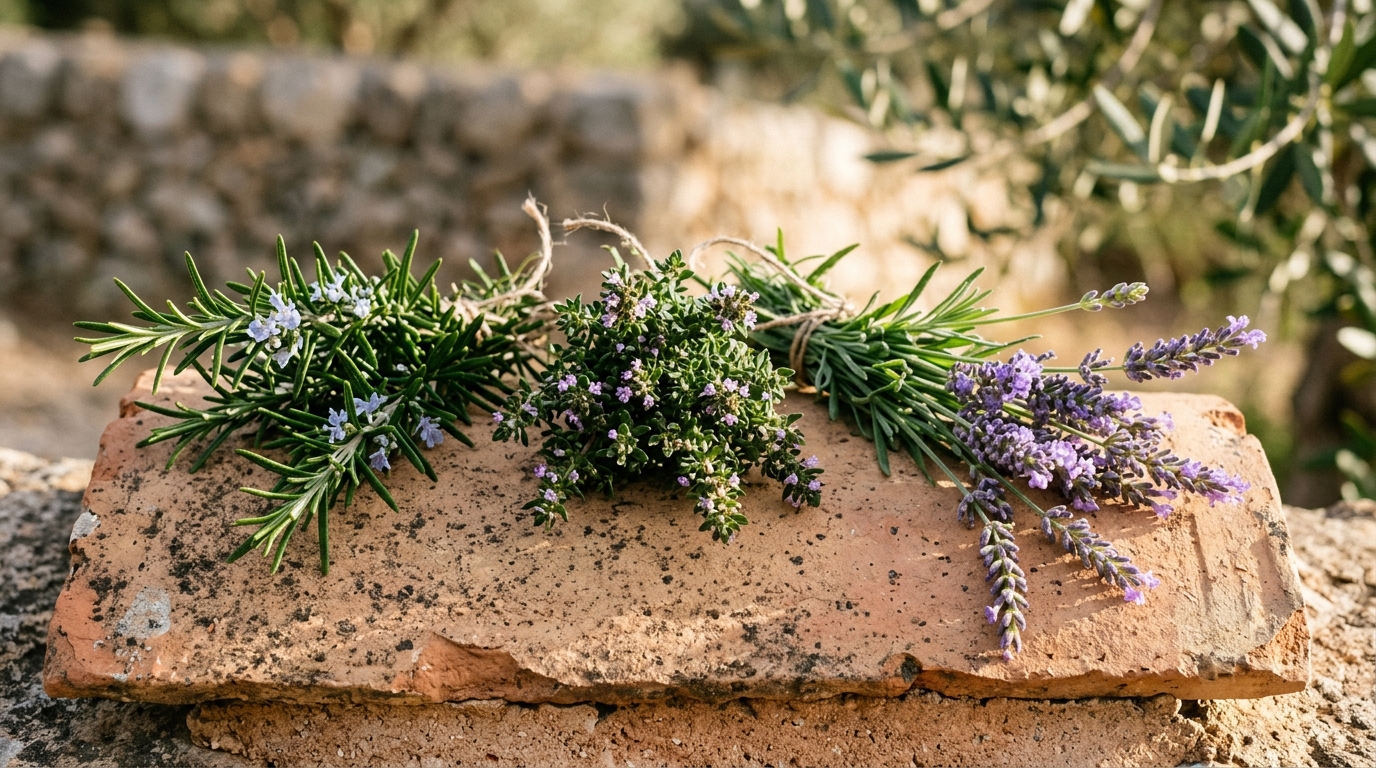
Rosemary (Rosmarinus officinalis) is perhaps the most ubiquitous aromatic plant in Mallorca. It can be found growing wild along the paths that lead to the beach or on the hiking routes that cross the flat areas of the Mallorcan landscape. Its resinous and persistent scent is, for many visitors, the smell of the island.
The Romans and Phoenicians already cultivated it diligently on the island, and its use has not diminished in the slightest. In cooking, it flavours roasted meats, lamb stews and rustic breads. In traditional medicine, it is used in infusions and baths to relieve muscle pain and improve circulation. In cosmetics, its essential oil is a common active ingredient in artisan soaps and hair-care products. Rosemary is, in short, an aromatic plant with three lives: culinary, medicinal and cosmetic.
Thyme: small and powerful
Thyme (Thymus vulgaris) grows close to the ground, almost invisible among the stones, but its aromatic impact is enormous. With its pungent scent, it is a favourite culinary spice among the inhabitants of the Mediterranean and an aromatic plant highly prized by lovers of medicinal herbs. Its purple flowers herald summer in the fields of Mallorca.
Medicinally, thyme essential oil stands out for its action on the respiratory tract: it shows its power especially against coughs, colds and has an expectorant effect on bronchial and sinus conditions. In Mallorcan cuisine, it seasons soups, rice dishes and game. Its combination with extra virgin olive oil—such as Treurer EVOO—creates dressings of exceptional aromatic depth.
Lavender: the perfume of the Mediterranean
Mallorcan lavender has an identity of its own. Its delicate scent is reminiscent of the Mediterranean Sea in summer, and its cultivation on the island produces high-quality essential oils, prized both in perfumery and in natural cosmetics. It is not uncommon to find in the artisan markets of Mallorca perfumes and soaps made with this aromatic plant grown on the island itself.
Its relaxing properties make it an ally for those seeking rest and wellbeing. Spraying the pillow with lavender water or adding a few drops of its essential oil to a warm bath are rituals that Mallorcans have practised for generations. At the wellness retreats held at estates such as Treurer, lavender appears as a sensory element that connects the visitor with the natural surroundings of the island.
Fennel, chamomile and lemon verbena: the digestive trio
These three aromatic plants form the core of Mallorcan digestive phytotherapy. Fennel is an effective and traditional remedy for treating digestive complaints when taken as an infusion, and it is also a very common ingredient in Mediterranean cuisine recipes. Its yellow flowers adorn the island’s fields during the summer months.
Chamomile, with its characteristic white flowers, relieves stomach complaints and liver conditions when taken as an infusion. When inhaled, it provides relief in respiratory illnesses. Lemon verbena (herba lluïsa in Mallorcan), for its part, is a true calming treasure among the island’s aromatic plants: it contains bioactive compounds such as citral and limonene, traditionally associated with relaxing effects and promoting states of calm. Its citrus scent also makes it irresistible in the kitchen, where it flavours desserts and homemade liqueurs.
Myrtle: the myrtle of the Balearic forests
Myrtle (Myrtus communis), also known as common myrtle, is one of the most emblematic aromatic plants of the Balearic Mediterranean and yet one of the least known outside the island. It is present in Mallorca, Menorca and Ibiza, and is listed in the Balearic Catalogue of Protected Flora, which gives an idea of its ecological and cultural importance. Its evergreen, leathery, deep-green leaves release an unmistakable scent when rubbed.
In Mallorcan tradition, myrtle has uses spanning all three major areas of the island’s herbs. Its ripe berries are edible and are used to flavour liqueurs, sauces and pork dishes, adding a bittersweet and spiced nuance that no other plant replicates. Medicinally, the Herbari Virtual del Mediterrani Occidental of the UIB documents it with aromatic, medicinal and perfumery properties. Its main compound, myrtle oil, gives it balsamic and antiseptic properties, especially useful in respiratory conditions. In cosmetics, “angel water”—a historic distillate of its flowers and leaves—has been used for centuries as a facial tonic. Today, its extracts appear in creams and ointments that make use of its anti-inflammatory and antimicrobial properties.
Researcher Esperança Carrió documented the traditional uses of myrtle in Mallorca in her work Contribució a l’etnobotànica de Mallorca. La biodiversitat i la seva gestió en una illa mediterrània (2013), a fundamental reference for understanding how this aromatic plant has been part of everyday life in localities such as Escorca and Sóller for generations.
Sage and spike lavender: two allies that complete the catalogue
The catalogue of Mallorcan aromatic plants would not be complete without sage (Salvia officinalis) and spike lavender (Lavandula latifolia), the wild cousin of cultivated lavender. Sage, with its powerful and slightly camphor-like scent, is a classic seasoning for fatty meats and a traditional remedy for sore throats and gum complaints. Spike lavender, more rustic and hardy than lavender, grows spontaneously on the stony slopes of the Tramuntana and produces an essential oil highly prized in aromatherapy for its balancing effect. Both are equally valuable aromatic plants in the island’s popular phytotherapy.
Culinary uses: the flavour that defines Mallorcan cuisine
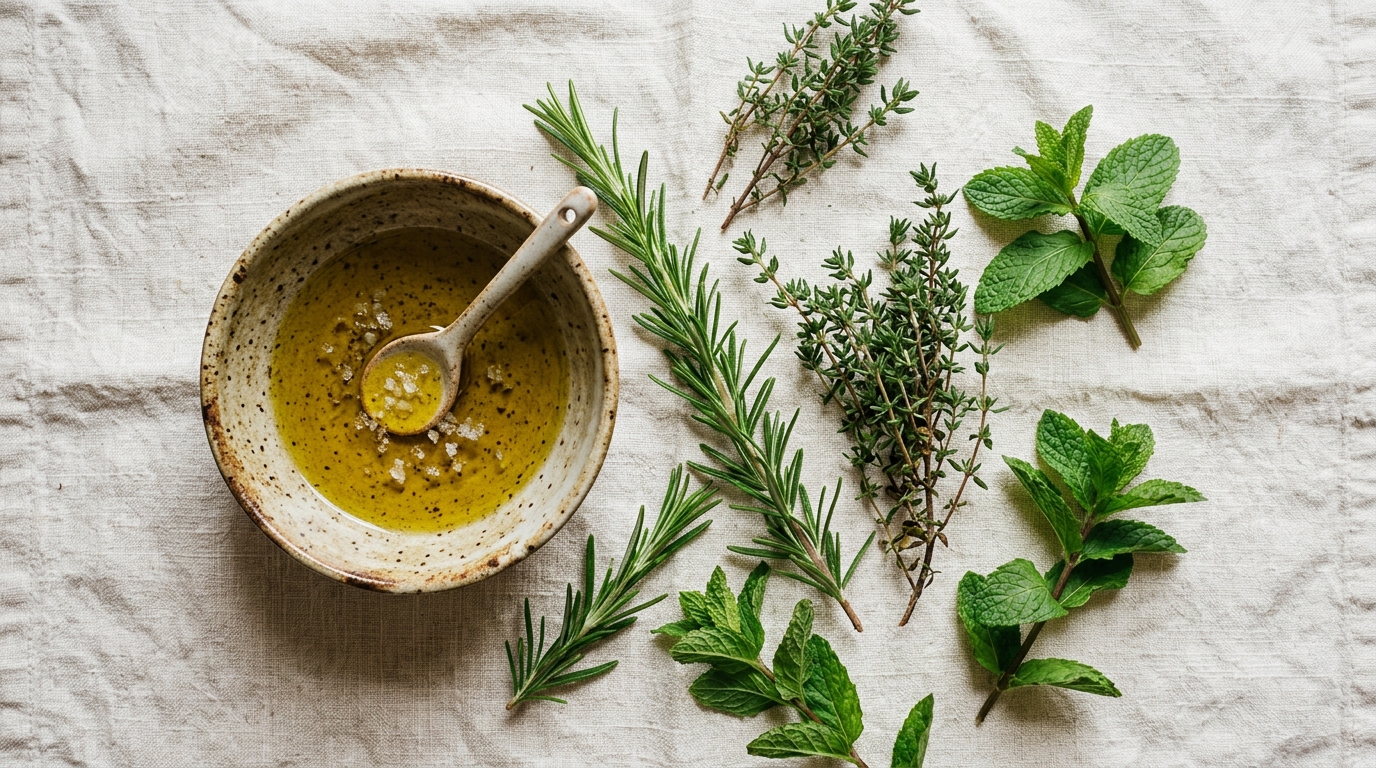
Mallorcan gastronomy cannot be understood without its aromatic plants. From frit mallorquí to pa amb oli, local herbs are the common thread that gives character to the island’s dishes. Incorporating these aromatic plants into everyday cooking is, before being a trend, a centuries-old tradition.
Rosemary and thyme perfume roasted lamb and pork, the stars of Mallorcan tables at festivities and family gatherings. Fresh fennel accompanies fish and seafood, adding freshness and complexity. Chamomile is used to flavour some traditional sweets. And lemon verbena gives a citrus and floral touch to desserts, artisan ice creams and homemade liqueurs. All these aromatic plants together form a pantry of flavours that defines the culinary identity of the island.
At Finca Treurer, cooking with local aromatic plants takes on a special dimension when combined with Treurer extra virgin olive oil. A drizzle of Treurer EVOO over a bruschetta with fresh rosemary, or a thyme and oil dressing for a seasonal vegetable carpaccio, are examples of how the simplicity and quality of the local ingredient become a memorable gastronomic experience.
Quick-reference table of uses by aromatic plant
A visual summary to always have the properties of the island’s main herbs at hand:
| Plant | Culinary use | Medicinal use | Cosmetic use |
|---|---|---|---|
| Rosemary | Roasted meats, breads, dressings | Circulation, muscle pain | Anti-hair-loss shampoo, soaps |
| Thyme | Soups, rice dishes, game | Respiratory tract, expectorant | Antimicrobial body creams |
| Lavender | Desserts, infusions, liqueurs | Relaxant, insomnia | Perfumes, soaps, floral water |
| Fennel | Fish, seafood, salads | Digestive, carminative | Essential oil for massage |
| Chamomile | Sweets, infusions | Stomach, liver, respiratory | Calming tonic for sensitive skin |
| Lemon verbena | Desserts, ice creams, liqueurs | Relaxant, promotes sleep | Aromatherapy, eau de cologne |
| Myrtle | Liqueurs, sauces, pork | Balsamic, respiratory antiseptic | Facial tonic (“angel water”) |
| Sage | Fatty meats, stuffings | Throat, gums, perspiration | Deodorants, antibacterial creams |
Hierbas de Mallorca: when tradition becomes a liqueur
No review of the island’s aromatic plants would be complete without mentioning Hierbas de Mallorca, the most emblematic liqueur of the archipelago. Its roots go back to the times when apothecaries and monks in the monasteries mixed spirits with wild herbs that served as medicinal remedies. What began as medicine ended up becoming a cultural tradition.
Today, Hierbas de Mallorca holds a Protected Geographical Indication (PGI) and is produced exclusively on the island. Its essential ingredients include lemon verbena, chamomile, orange tree, lemon tree, rosemary, melissa and fennel, all of them aromatic plants produced in Mallorca. The process consists of a long, slow maceration of these aromatic plants in distilled anise, which gives the liqueur its colour and unmistakable character.
The family tradition of preparing the liqueur in May—when the aromatic plants are at their optimal freshness—is still alive in many Mallorcan homes. Gathering to select and combine the right aromatic plants is an essential part of the ritual. It is a process that unites generations and preserves popular botanical knowledge in a way that is as tasty as it is effective.
Cosmetic uses: beauty born from the countryside
Natural cosmetics with Mallorcan aromatic plants have experienced a notable rise in recent years, driven by growing demand for clean, local and sustainable products. Extra virgin olive oil combined with essential oils of rosemary or lavender gives rise to artisan soaps, shampoos and creams of an efficacy and fragrance difficult to match with synthetic ingredients.
- Rosemary → hair stimulant: it is attributed the ability to activate circulation in the scalp and promote the health of the hair follicle; it is the star ingredient in anti-hair-loss shampoos and masks.
- Lavender → calming and antiseptic: ideal for sensitive or acne-prone skin; used in floral waters, creams and toilet soaps.
- Thyme → antimicrobial: its antibacterial properties make it valuable in body creams, shower gels and intimate hygiene products.
- Myrtle → toning and astringent: myrtle essential oil is of interest to major cosmetics brands for its action on the skin; historically it was distilled to obtain “angel water”, a facial tonic with a firming effect.
- Chamomile → softening: in the form of a concentrated infusion, it lightens and softens blonde hair and soothes redness in delicate skin.
- Sage → regulating: it controls excess perspiration and has antibacterial properties that make it useful in deodorants and foot creams.
At Finca Treurer, the connection between EVOO and natural cosmetics is evident: Treurer extra virgin olive oil not only nourishes from within, but has also inspired lines of body care in which locally sourced aromatic plants are the starting point. Using a first cold-pressed olive oil on the skin is, in essence, applying centuries of Mediterranean wisdom.
Traditional medicine: knowledge that is never forgotten
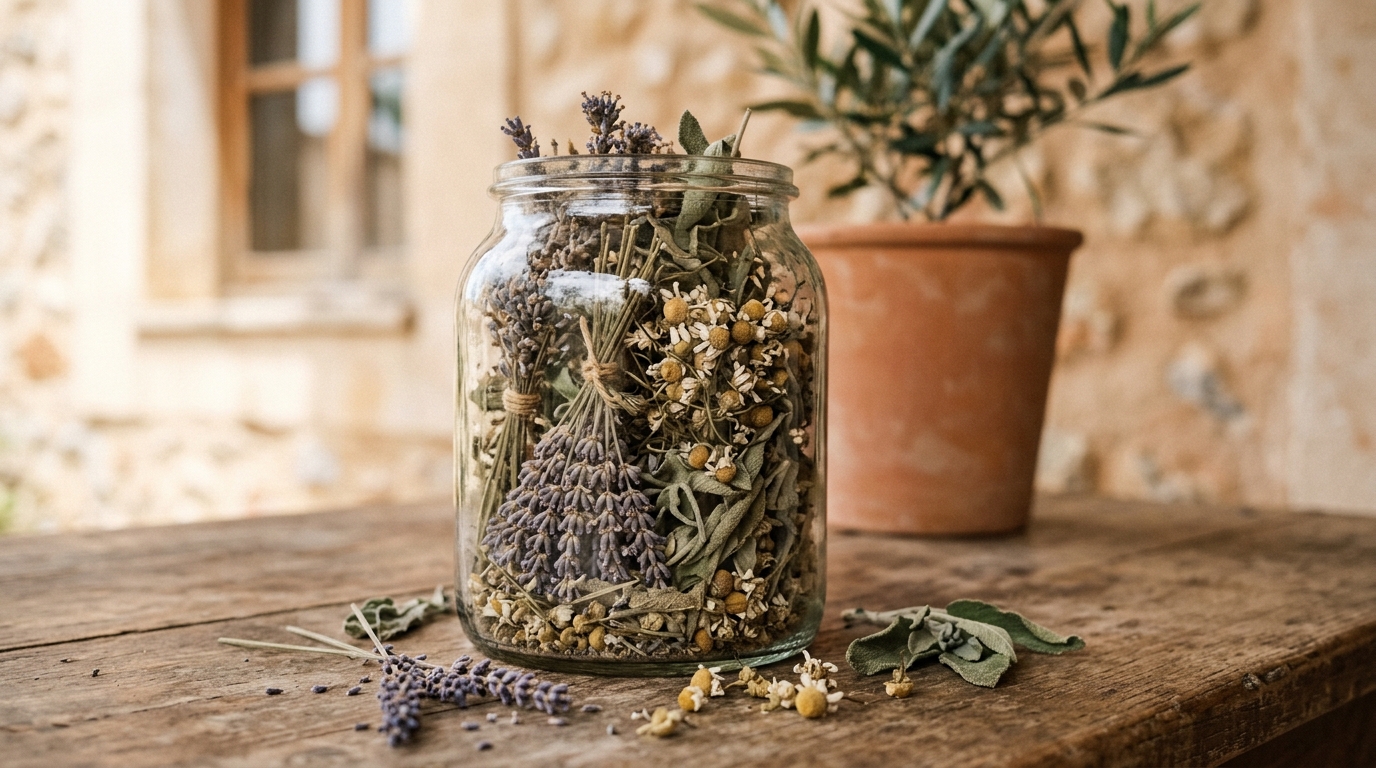
Mallorcan traditional medicine is a system of oral knowledge passed down from generation to generation, in which aromatic plants occupy a central place. Monasteries and ecclesiastical communities played an important role in obtaining distillates that, originally, had curative and medicinal purposes. Tradition also links the Mallorcan Ramon Llull (13th–14th centuries) with the first contributions to the distillation process on the island.
This legacy lives on today in popular phytotherapy. Chamomile infusions for the stomach, rosemary baths for muscle pain, lemon verbena to aid sleep or thyme steam inhalations for colds are plant-based remedies that any Mallorcan of a certain age remembers from their childhood. These are not superstitions: they are empirical knowledge accumulated over centuries that modern science is progressively confirming.
The Balearic ethnobotanical heritage now has rigorous academic documentation. Researcher Esperança Carrió published in 2013 her thesis Contribució a l’etnobotànica de Mallorca. La biodiversitat i la seva gestió en una illa mediterrània, a reference work that compares the therapeutic uses of Balearic aromatic plants with those described in other Mediterranean traditional medicines. Her work demonstrates that the botanical wisdom of Mallorca forms part of a universal dialogue about health and nature, and that species such as myrtle, rosemary and lemon verbena have documented use in specific localities on the island. For its part, the Universitat de les Illes Balears (UIB) maintains the Herbari Virtual del Mediterrani Occidental, an open database that catalogues the Balearic flora and its properties, and which serves as a reference both for researchers and for anyone curious who wishes to delve deeper into the subject.
Sustainability and responsible harvesting
The growing interest in aromatic plants brings with it a responsibility: to harvest sustainably so as not to compromise the balance of the ecosystem. In Mallorca, some wild species are under pressure from overexploitation and mass tourism in protected natural areas.
Responsible harvesting of aromatic plants means taking only what is necessary, respecting flowering periods and always preferring home cultivation or purchasing from certified local producers. Choosing aromatic plants cultivated on the island is also a way of sustaining the local agricultural economy and ensuring that traditional botanical knowledge is not lost. Initiatives such as that of Estel de Llevant, which cultivates aromatic plants organically on the island in collaboration with the UIB, show that the sector has a future when it is approached with rigour and respect for the land.
At Finca Treurer, sustainability is not a slogan: it is a daily practice reflected in the management of the olive grove, in respect for natural cycles and in the conviction that a well-tended land is the best ingredient in any quality product. The aromatic plants that grow among the olive trees at Treurer are part of that ecosystem, protected with the same care devoted to every olive.
How to live the aromatic experience in Mallorca
If you want to go beyond reading and immerse yourself in the world of Mallorcan aromatic plants, the island offers extraordinary possibilities. Artisan markets are the first port of call: the Sineu market, held every Wednesday from 8:00 to 13:30, is probably the most authentic on the island, where farmers from the interior sell fresh and dried aromatic plants alongside oil, cheese and sobrasada. The Pollença market is held on Sundays, and the Llucmajor market on Wednesdays and Sundays: at all of them you will find local producers with seasonal herbs, essential oils and natural preparations.
The hiking routes through the Serra de Tramuntana are another privileged setting for discovering aromatic plants in their natural habitat. The GR-221 or Ruta de Pedra en Sec—140 kilometres traversing the Tramuntana, declared a UNESCO World Heritage Site, from Port d’Andratx to Pollença—passes through landscapes where rosemary, thyme, spike lavender and myrtle grow on both sides of the path. Walking among wild aromatic plants while the sun warms the limestone rocks is a sensory experience that no shop can reproduce.
For a deeper immersion, the wellness retreats at Finca Treurer incorporate the aromatic surroundings of the estate as a central element: the centuries-old olive trees, the aromatic plants that grow among them and the landscape of the Mallorcan interior become the setting for an experience that connects the visitor with the most authentic essence of the island.
Frequently asked questions
When is the best time to harvest aromatic plants in Mallorca?
The optimal time varies depending on the plant, but in general spring and the beginning of summer—between April and June—are the months of highest concentration of essential oils in Mediterranean herbs. Rosemary and thyme are harvested just before or during flowering; lavender when the stems are in flower but have not yet fully opened. The Mallorcan tradition of preparing Hierbas de Mallorca in May responds precisely to this principle: the aromatic plants are at their optimal freshness and aromatic potency.
What is the difference between lavender and spike lavender?
Although they belong to the same genus (Lavandula), they are distinct species. Cultivated lavender (Lavandula angustifolia) has a finer, sweeter scent, and its essential oil is the most prized in perfumery and cosmetics. Spike lavender (Lavandula latifolia) grows wild on the stony slopes of the Tramuntana, has a more rustic and camphor-like scent, and produces a more affordable but equally effective essential oil in aromatherapy and medicinal uses. In Mallorcan markets, both aromatic plants are sometimes sold under the same name, so it is worth asking the producer.
Can I harvest wild aromatic plants in Mallorca?
Yes, but with precautions. Harvesting for personal use and in small quantities is generally permitted in non-protected areas, but it is prohibited in the protected natural spaces of the Serra de Tramuntana and other areas of the Natura 2000 Network. Furthermore, myrtle is listed in the Balearic Catalogue of Protected Flora, so its harvesting is especially regulated. The most sustainable alternative is to buy from certified local producers or to grow your own aromatic plants in pots.
Which aromatic plants from Mallorca are the easiest to grow at home?
Thyme, rosemary and chamomile are the most rewarding aromatic plants for home cultivation: they require little watering, plenty of sun and a well-drained substrate, exactly the conditions that mimic their natural habitat on the island. Lemon verbena grows well in a large pot on a sunny balcony. Lavender prefers the ground to a pot, but tolerates container growing if sandy soil is used and watering is moderate. All of them adapt well to the continental Mediterranean climate.
What precautions should I take when using Mallorcan medicinal plants?
Aromatic plants are a valuable complement, but they are not without contraindications. Thyme and sage are inadvisable in high doses during pregnancy; rosemary may enhance the effect of anticoagulant medications; and lemon verbena, in very concentrated or prolonged infusions, may irritate the kidneys in people with renal problems. Always consult a doctor or pharmacist before using herbs for therapeutic purposes, especially if you take regular medication.
Sources
{“@context”:”https://schema.org”,”@type”:”FAQPage”,”inLanguage”:”en”,”mainEntity”:[{“@type”:”Question”,”name”:”When is the best time to harvest aromatic plants in Mallorca?”,”acceptedAnswer”:{“@type”:”Answer”,”text”:”\u003Cp\u003EThe optimal time varies depending on the plant, but in general \u003Cstrong\u003Espring and the beginning of summer\u003C/strong\u003E—between April and June—are the months of highest concentration of essential oils in Mediterranean herbs. Rosemary and thyme are harvested just before or during flowering; lavender when the stems are in flower but have not yet fully opened. The Mallorcan tradition of preparing Hierbas de Mallorca in May responds precisely to this principle: the aromatic plants are at their optimal freshness and aromatic potency.\u003C/p\u003E”}},{“@type”:”Question”,”name”:”What is the difference between lavender and spike lavender?”,”acceptedAnswer”:{“@type”:”Answer”,”text”:”\u003Cp\u003EAlthough they belong to the same genus (\u003Cem\u003ELavandula\u003C/em\u003E), they are distinct species. Cultivated lavender (\u003Cem\u003ELavandula angustifolia\u003C/em\u003E) has a finer, sweeter scent, and its essential oil is the most prized in perfumery and cosmetics. Spike lavender (\u003Cem\u003ELavandula latifolia\u003C/em\u003E) grows wild on the stony slopes of the Tramuntana, has a more rustic and camphor-like scent, and \u003Cstrong\u003Eproduces a more affordable but equally effective essential oil\u003C/strong\u003E in aromatherapy and medicinal uses. In Mallorcan markets, both aromatic plants are sometimes sold under the same name, so it is worth asking the producer.\u003C/p\u003E”}},{“@type”:”Question”,”name”:”Can I harvest wild aromatic plants in Mallorca?”,”acceptedAnswer”:{“@type”:”Answer”,”text”:”\u003Cp\u003EYes, but with precautions. Harvesting for personal use and in small quantities is generally permitted in non-protected areas, but \u003Cstrong\u003Eit is prohibited in the protected natural spaces\u003C/strong\u003E of the Serra de Tramuntana and other areas of the Natura 2000 Network. Furthermore, myrtle is listed in the Balearic Catalogue of Protected Flora, so its harvesting is especially regulated. The most sustainable alternative is to buy from certified local producers or to grow your own aromatic plants in pots.\u003C/p\u003E”}},{“@type”:”Question”,”name”:”Which aromatic plants from Mallorca are the easiest to grow at home?”,”acceptedAnswer”:{“@type”:”Answer”,”text”:”\u003Cp\u003EThyme, rosemary and chamomile are the most rewarding aromatic plants for home cultivation: \u003Cstrong\u003Ethey require little watering, plenty of sun and a well-drained substrate\u003C/strong\u003E, exactly the conditions that mimic their natural habitat on the island. Lemon verbena grows well in a large pot on a sunny balcony. Lavender prefers the ground to a pot, but tolerates container growing if sandy soil is used and watering is moderate. All of them adapt well to the continental Mediterranean climate.\u003C/p\u003E”}},{“@type”:”Question”,”name”:”What precautions should I take when using Mallorcan medicinal plants?”,”acceptedAnswer”:{“@type”:”Answer”,”text”:”\u003Cp\u003EAromatic plants are a valuable complement, but they are not without contraindications. \u003Cstrong\u003EThyme and sage are inadvisable in high doses during pregnancy\u003C/strong\u003E; rosemary may enhance the effect of anticoagulant medications; and lemon verbena, in very concentrated or prolonged infusions, may irritate the kidneys in people with renal problems. Always consult a doctor or pharmacist before using herbs for therapeutic purposes, especially if you take regular medication.\u003C/p\u003E”}}]}


