- Qué es el AOVE y por qué no todos los aceites de oliva son iguales
- Los polifenoles del AOVE: el motor de sus propiedades
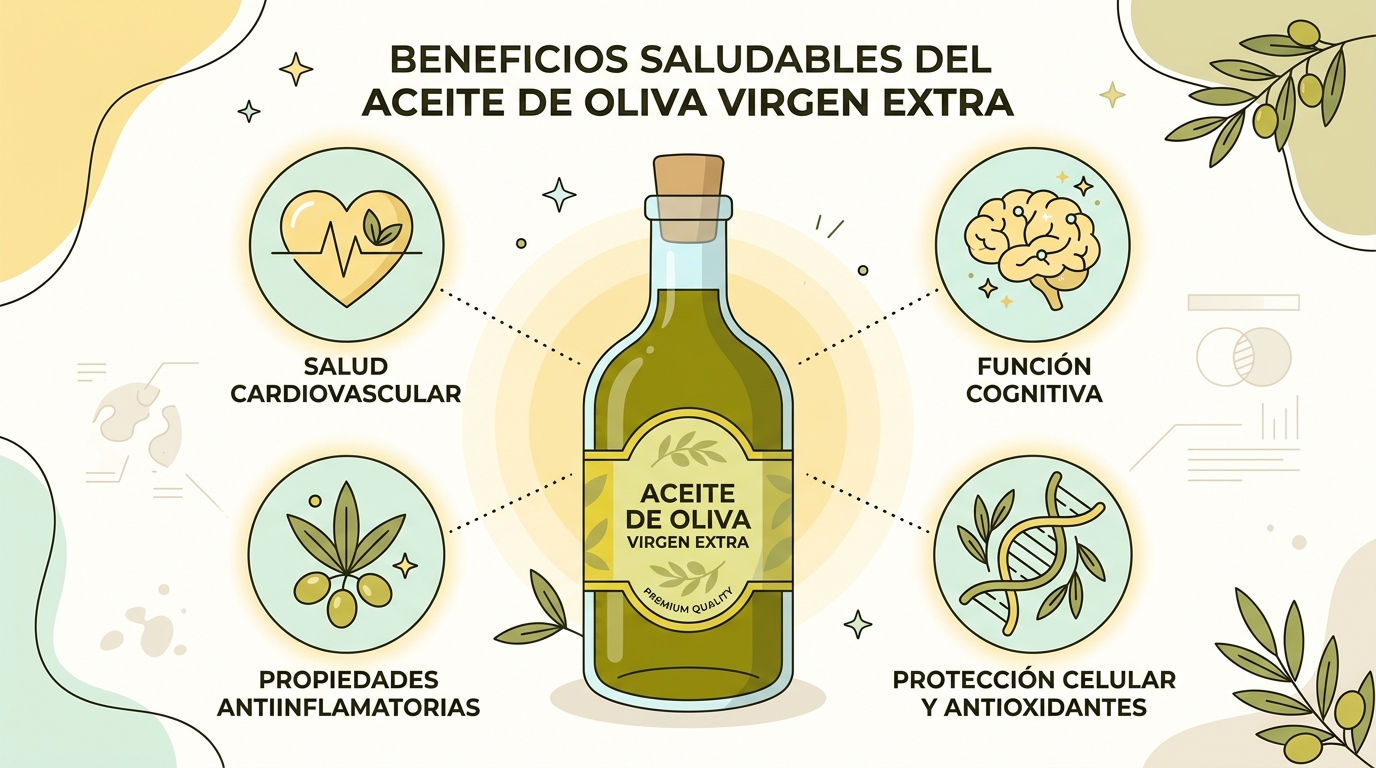
- Beneficios del AOVE para la salud cardiovascular
- AOVE, dieta mediterránea y longevidad
- Propiedades antioxidantes y acción antiinflamatoria sistémica
- AOVE y salud metabólica: diabetes tipo 2 y síndrome metabólico
- Neuroprotección: AOVE frente al deterioro cognitivo
- Potencial anticancerígeno y salud intestinal
- Variedades de aceituna y contenido en polifenoles
- Cómo incorporar el AOVE en la dieta diaria
- Cómo elegir y conservar un AOVE de calidad
- Preguntas frecuentes
Contenidos / Contents
Qué es el AOVE y por qué no todos los aceites de oliva son iguales
El aceite de oliva virgen extra (AOVE) es la categoría de mayor calidad dentro de los aceites de oliva. Se obtiene exclusivamente por medios mecánicos, lo que permite conservar sus antioxidantes, polifenoles, vitaminas y otros compuestos bioactivos. Este proceso, libre de tratamientos térmicos o químicos, es precisamente lo que lo diferencia del aceite refinado.El aceite refinado atraviesa tratamientos industriales que degradan estos componentes beneficiosos. La consecuencia es directa: solo los aceites de oliva vírgenes, no los refinados, se asocian con menor mortalidad total, y estos beneficios no son extrapolables a aceites refinados, incluso cuando comparten un perfil calórico similar.Su alto contenido de ácidos grasos monoinsaturados, especialmente ácido oleico, junto con su rica composición en compuestos bioactivos, le confiere propiedades antioxidantes, antiinflamatorias y protectoras cardiovasculares. Comprender esta distinción es el primer paso para aprovechar todo lo que la ciencia ha documentado sobre este alimento.Revisado con criterios de evidencia científica por el equipo editorial de Treurer, con el asesoramiento de profesionales del ámbito de la nutrición y la oleicultura.Pocas familias de moléculas han generado tanto interés en la investigación nutricional como los polifenoles del AOVE. El aceite de oliva virgen extra contiene altas concentraciones de polifenoles —como el hidroxitirosol y el oleocantal— con propiedades neuroprotectoras, antiinflamatorias y antimicrobianas. No se trata de un único compuesto, sino de un conjunto de moléculas que actúan de forma coordinada.
Hidroxitirosol: el antioxidante de referencia
Los polifenoles actúan como antioxidantes que protegen las células del daño oxidativo, a la vez que disminuyen la inflamación sistémica, un factor de riesgo clave para la progresión de la enfermedad arterial coronaria. El hidroxitirosol es uno de los más potentes en este sentido, y su presencia en el AOVE está directamente vinculada al control de la inflamación vascular.
Investigaciones científicas han demostrado que el consumo diario de hidroxitirosol, pequeño pero muy potente compuesto antioxidante fenólico presente en el AOVE, previene los problemas vasculares derivados de la enfermedad diabética. La ingesta de 0,5 mg a 2,5 mg de hidroxitirosol diarios —presentes en las 3-4 cucharadas diarias de AOVE recomendadas— serían suficientes para reducir la inflamación vascular asociada a la diabetes.
Oleocantal: el antiinflamatorio natural del AOVE
El oleocantal es responsable del sabor amargo y picante del aceite de oliva virgen extra, y tiene propiedades antiinflamatorias similares a las del antiinflamatorio no esteroideo ibuprofeno. Este compuesto, exclusivo del AOVE de calidad, ha acumulado un creciente cuerpo de evidencia científica.
Investigaciones recientes han revelado que el oleocantal inhibe significativamente la producción de citocinas proinflamatorias y reduce la expresión de genes inflamatorios, contrarresta el estrés oxidativo y aumenta la actividad fagocítica celular. Su acción se extiende, además, al ámbito neurológico, como se detalla más adelante.
Aceite de oliva virgen extra y salud: ¿Cómo ayuda a tu salud cardiovascular?
La salud cardiovascular es el ámbito donde la evidencia científica sobre el AOVE resulta más sólida y extensa. La relación entre el consumo de aceite de oliva extra virgen y la salud cardiovascular se ha consolidado a partir de evidencia recogida por universidades de referencia mundial y grandes ensayos clínicos con miles de participantes.
El estudio PREDIMED: la evidencia más robusta
Uno de los estudios más representativos es el PREDIMED (Prevención con Dieta Mediterránea), realizado en España con 7.447 participantes. Los resultados mostraron que una dieta suplementada con aceite de oliva virgen extra redujo en un 30% el riesgo relativo de sufrir enfermedades cardiovasculares mayores —infarto, ictus o muerte cardiovascular— en comparación con una dieta baja en grasas.
Además, el análisis del estudio PREDIMED mostró que cuanto mayor era el aporte de polifenoles del AOVE, mayores eran los beneficios para la salud. Este hallazgo refuerza la importancia de elegir un aceite de alta calidad, con concentraciones elevadas de compuestos fenólicos.
Control del colesterol y la presión arterial
El AOVE contribuye a disminuir los niveles de LDL en el organismo gracias a su contenido en antioxidantes, como los polifenoles, que protegen las partículas de LDL de la oxidación. El colesterol LDL es responsable de la acumulación de placa en las arterias, lo que puede llevar a aterosclerosis, infartos y accidentes cerebrovasculares. La oxidación del LDL es un paso crucial en el desarrollo de la enfermedad cardiovascular, por lo que la protección contra este proceso es un beneficio significativo del AOVE.
Diversos estudios han demostrado que el consumo regular de aceite de oliva virgen extra puede ayudar a controlar la presión arterial, pues los polifenoles presentes tienen propiedades vasodilatadoras que contribuyen a la relajación y expansión de los vasos sanguíneos, facilitando el flujo sanguíneo.
AOVE, dieta mediterránea y longevidad

El aceite de oliva, especialmente en su forma virgen extra, es un componente esencial de la dieta mediterránea, ampliamente asociado con menores tasas de enfermedad cardiovascular y mortalidad. Este patrón dietético prioriza el AOVE como principal fuente de grasa, lo que contribuye de manera significativa a la salud cardiovascular al ofrecer propiedades antioxidantes, antiinflamatorias y cardioprotectoras.
Según la Harvard T.H. Chan School of Public Health, la inclusión habitual de aceite de oliva extra virgen en la alimentación contribuye a reducir el riesgo de enfermedades cardíacas y mortalidad asociada. Esta afirmación se sustenta en estudios difundidos por The American Journal of Clinical Nutrition, los cuales muestran que quienes incorporan este aceite en su dieta presentan menores tasas de mortalidad por causas cardiovasculares en comparación con los que optan por otras fuentes de grasa.
El aceite de oliva virgen extra no es solo una grasa culinaria, sino un alimento funcional con efectos demostrados sobre la salud cardiovascular, metabólica, cerebral y la longevidad. Esta caracterización, cada vez más aceptada en la literatura científica, sitúa al AOVE en una categoría diferente a la de cualquier otro aceite vegetal.
Propiedades antioxidantes y acción antiinflamatoria sistémica

Los polifenoles son sustancias conocidas por su poder antiinflamatorio y antitrombótico, que ejercen un efecto cardioprotector frente a la arteriosclerosis, un proceso de estrechamiento y endurecimiento de las arterias. La arteriosclerosis es responsable de un gran número de enfermedades cardiovasculares, entre ellas la hipertensión arterial.
La inflamación crónica de bajo grado es hoy reconocida como un factor subyacente en enfermedades tan diversas como la obesidad, el síndrome metabólico o las patologías autoinmunes. Incluso una sola comida con AOVE produce una respuesta inflamatoria más favorable que con aceite de girasol. Este efecto agudo, observable tras una única ingesta, ilustra la potencia de sus compuestos bioactivos.
AOVE y salud metabólica: diabetes tipo 2 y síndrome metabólico
Las dietas ricas en AOVE han demostrado ser un aliado invaluable en la prevención y la gestión de enfermedades crónicas como la resistencia a la insulina y el síndrome metabólico. La investigación en este campo ha avanzado notablemente en los últimos años.
Un ensayo clínico aleatorizado de 24 semanas evaluó los efectos del aceite de oliva virgen extra, rico en compuestos fenólicos, sobre el control glucémico de 116 adultos con diabetes de tipo 2 y demostró reducciones significativas en la resistencia a la insulina en el grupo de intervención.
La investigación revisa los mecanismos moleculares mediante los cuales los compuestos bioactivos del aceite de oliva podrían modular la resistencia a la insulina, reducir la inflamación y proteger la función de las células beta pancreáticas. Estudios internacionales han demostrado que el consumo de oleuropeína, uno de los compuestos fenólicos antioxidantes del AOVE, reduce los niveles de glucosa en sangre después de las comidas.
La evidencia reciente sostiene que llevar una dieta mediterránea reduce el riesgo de que las personas desarrollen diabetes tipo 2 y, en el caso de pacientes que ya tienen esta enfermedad, dicha dieta mejora el control glucémico y ofrece protección cardiovascular.
Neuroprotección: AOVE frente al deterioro cognitivo

El AOVE protege el cerebro a través de varios mecanismos simultáneos: sus ácidos grasos monoinsaturados y antioxidantes naturales contribuyen a la integridad de las membranas neuronales y a la comunicación entre neuronas, mientras que sus polifenoles contrarrestan el estrés oxidativo, uno de los factores asociados al deterioro cognitivo.
Entre los polifenoles del AOVE, el más destacado en el ámbito neurológico es el oleocantal, que ha demostrado poseer propiedades antiinflamatorias y neuroprotectoras. El oleocantal mejora la eliminación de la proteína beta-amiloide de las neuronas y reduce la inflamación de los astrocitos, dos mecanismos directamente implicados en la patogénesis del Alzheimer.
Un estudio identificó además al género bacteriano Adlercreutzia como potencial marcador de la relación positiva entre el consumo de aceite de oliva extra virgen y la protección de la función cerebral, lo que apunta a que parte de los efectos neuroprotectores estarían mediados por la microbiota y su interacción con los compuestos del aceite.
Fuentes
- Aceite de Mallorca – Wikipedia, la enciclopedia libre
- Cómo integrar el AOVE en una alimentación saludable sin caer en mitos – Aceites Maeva
- Dieta mediterránea: menú semanal 7 días + lista de compra
- Variedades de aceituna y de aceite de oliva en España
- Diferencias entre Aceite de oliva: arbequina, picual u hojiblanca