Have you ever wondered why the villages of Mallorca seem to have grown from the earth itself? Vernacular Mallorcan architecture is not just a set of building techniques: it is the visual story of an island that learned to build with what it had, to protect itself from the heat without sacrificing beauty, and to leave a mark of its history on every facade. If you want to understand Mallorca beyond its beaches, start by looking at its stone walls.
Contenidos / Contents
What is vernacular Mallorcan architecture
The term “vernacular” refers to architecture that is born from the place itself, without signature architects or fashionable foreign influences. In Mallorca, this means building with the materials the island provides, following a Mediterranean climate that demands coolness in summer and protection in winter, and adapting every volume to a topography that ranges from the plains of the Pla to the steep slopes of the Serra de Tramuntana.
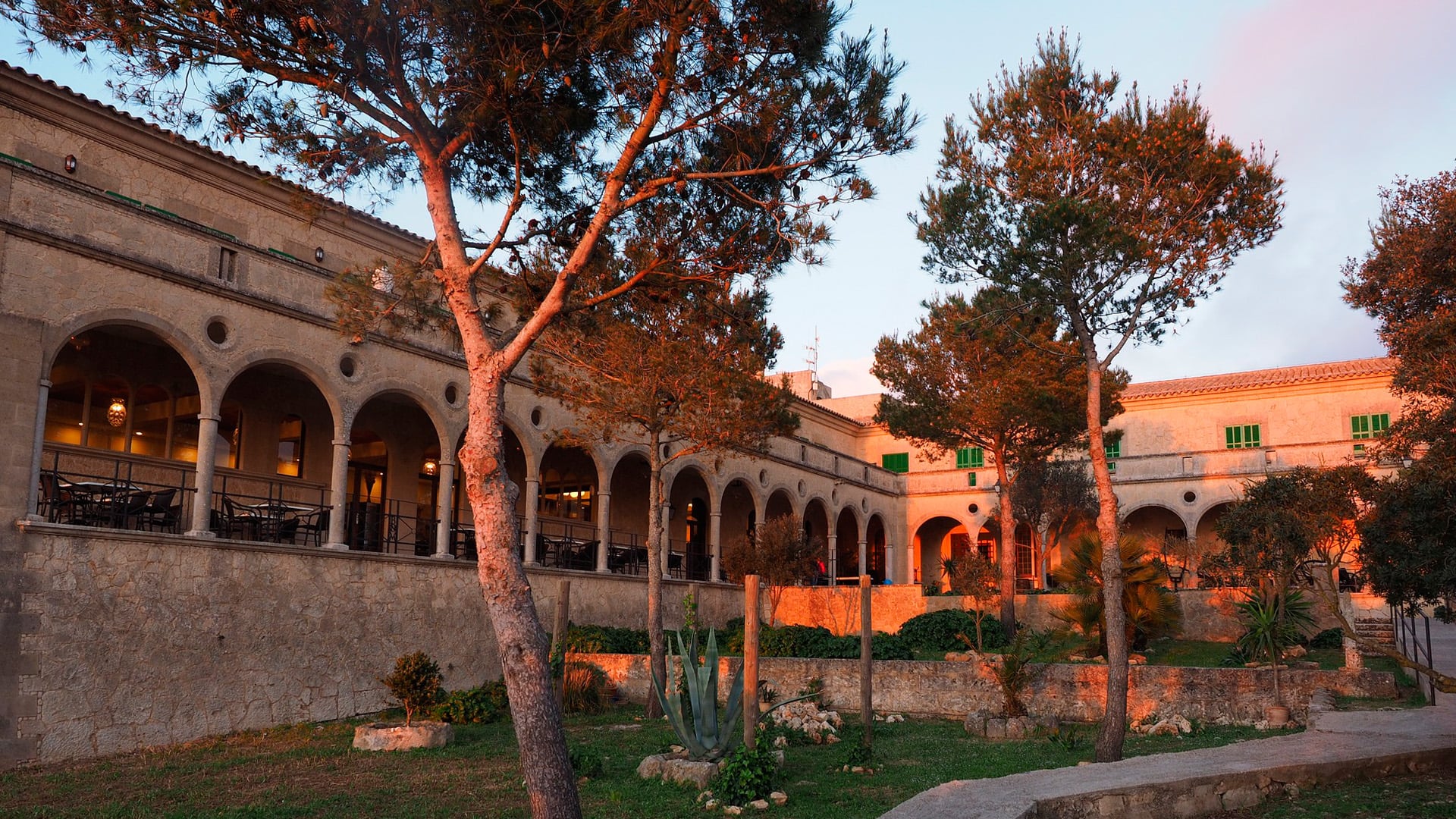
Properties in Mallorca display a style that combines functionality and beauty while respecting the natural surroundings. This is no aesthetic coincidence: it is the result of centuries of trial and error, of anonymous stonemasons and builders who knew exactly how thick a wall had to be to prevent the house from becoming an oven in August. Mallorcan cantería — the art of working stone with millimetric precision — is the backbone of this entire tradition.
Mallorcan architecture has evolved by absorbing the influences of every culture that set foot on the island. The oldest buildings bear the Roman and Arab imprint; the medieval ones, the Catalan and Gothic mark; those of the Baroque, an ornamental refinement that creeps into doorways and mouldings. The result is a layered architecture in which Arab solutions, medieval techniques and Baroque details coexist without any element seeming out of place.
Marès stone: the soul of traditional construction
If there is one material that defines Mallorcan architecture above all others, it is marès. It is a sedimentary calcarenite — geologically speaking, a rock formed by the lithification of sand dunes — with a rough, warm texture and a colour ranging from beige to golden. According to a study published on ResearchGate on marès stone, this material records the geological evolution of the island over the last 15 million years, from the middle Miocene to the upper Pleistocene, making it geological heritage as well as a building material.
These qualities have made it the preferred material for centuries in houses, religious buildings, walls, wells and cisterns. In Mallorca, marès is valued not only for its technical properties but also for its deep connection with the cultural and aesthetic identity of the island: from Palma Cathedral to the stately homes of the old town, through rural possessions and monasteries.
Technical advantages of marès
Marès is easy to extract and handle, and its use offers advantages that no industrial material has managed to surpass in the Mediterranean context. It requires virtually no maintenance or surface treatment with plaster or paint. Being a stone that “breathes”, it passively regulates interior humidity, making it ideal for the Balearic climate without the need for artificial air conditioning. This bioclimatic capacity is precisely what makes Mallorcan stone houses so comfortable in summer.
Due to geographical isolation, materials arriving from the mainland were very costly. Marès thus became the logical answer: abundant, manageable and perfectly adapted to the climate. It was used in Mallorca Cathedral, the Almudaina Palace, Bellver Castle and the walls of Palma. The architecture studio AP Arquitectos, specialists in Balearic construction, point out that choosing marès today is also a way of reactivating traditional quarries and contributing to a more conscious architecture.
Active quarries and their future
Currently in Mallorca there are sixteen active marès quarries (pedreres), distributed across municipalities such as Felanitx, Llucmajor, Campos, Manacor, Muro, Petra, Santa Margalida and Santanyí. Three remain in Menorca. Extraction has a very low environmental impact, but the progressive exhaustion of the quarries is a real threat to the continuity of the craft. One example of preservation is the Fundació Líthica, which since 1995 has managed the former quarries of S’Hostal in Ciutadella (Menorca) as a cultural and heritage space, saving them from oblivion.
Nevertheless, residential projects, boutique hotels and public spaces incorporate marès, wood and roof tiles into minimalist designs, achieving a symbiosis between the ancestral and the innovative. Quality contemporary Mallorcan architecture returns, time and again, to this material that smells of history.
Historic facades: an open book in stone
Approaching a historic Mallorcan facade is like reading a text written in stone. Every element has a reason for being, and understanding them transforms a stroll through any village into a completely different experience.
Thick walls and limestone
Traditional Mallorcan houses have stone facades and thick walls that act as a natural thermal barrier. The exposed faces are quite finely carved because limestone is relatively easy to polish. In the Serra de Tramuntana, where limestone is the dominant geological material, the villages seem to spring from the mountain because they are, literally, built from it: a coherence between landscape and construction that no imported style can imitate.
Arches, voussoirs and wrought iron
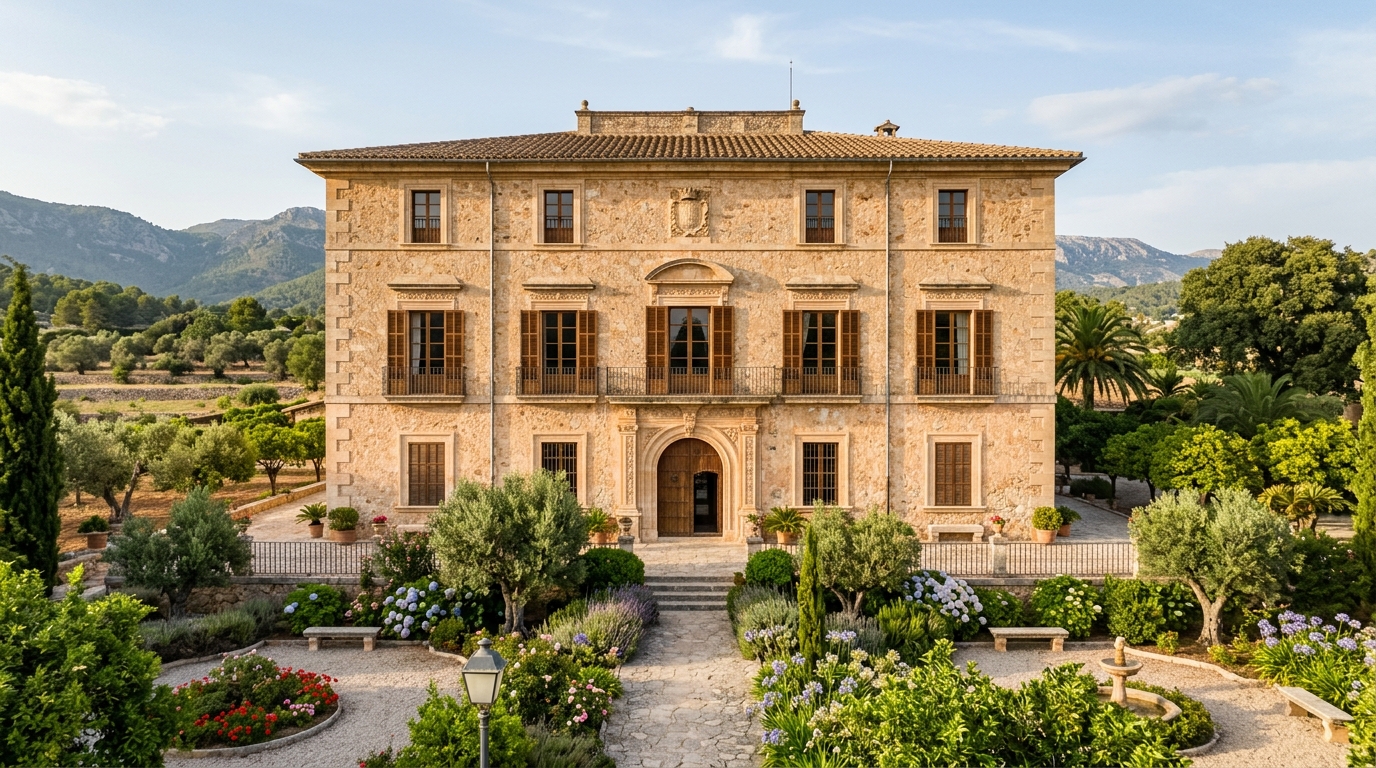
Another very notable element of these buildings is the round arch that supports doorways and windows. The jambs and lintel were formed from more polished limestone — a sign of the main entrance — while the voussoirs (the curved pieces of the arch) were carved in marès, whose granular structure is much easier to work than the layering of limestone. The wrought-iron details — grilles, balconies, door knockers — completed the facade: their design was not originally decorative but defensive, although over time local blacksmiths turned them into genuine works of craftsmanship.
Doors, shutters and eaves
Carved wooden doors and windows, together with Arabic ceramic roof tiles, are distinctive elements of the island’s popular architecture. The painted shutters — green, blue, ochre — regulate the entry of light and heat during the hottest hours of the day, functioning as a passive climate-control system that no modern appliance surpasses in elegance. The wooden or stone eaves that project over the windows complete this system: they protect the wall from rain and cast shade over the opening, reducing solar gain without darkening the interior.
Building typologies: from the casa payesa to the possessió
Rural Mallorcan architecture is not a uniform block: there are well-differentiated typologies according to scale, function and the owner’s status. The following table summarises the three main ones so you can recognise them on the ground.
| Typology | Scale and function | Distinctive elements | Visitable examples |
|---|---|---|---|
| Casa payesa | Rural agricultural dwelling, family scale | Thick marès walls, gabled roof, interior courtyard, wooden shutters | Villages of the Pla: Petra, Sineu, Algaida |
| Possessió (manor estate) | Large agricultural property with multiple outbuildings | Defensive tower, chapel, marjades, pedra en sec, formal gardens | Son Marroig (Deià), Raixa (Bunyola) |
| Alquería | Rural house of Islamic origin, enclosed structure | Central courtyard, interior fountain, inward orientation, private garden | Place names with the prefix “Ben-” or “Al-” in the island’s interior |
The casa payesa: a living machine
In the Mallorcan countryside, the casa payesa is the typology that best represents vernacular architecture. Robust, with thick stone walls, a gabled roof and an interior courtyard that allows natural ventilation, it is not a house designed to impress: it is a perfectly calibrated living machine for the climate and the agricultural way of life. The interior courtyards — of which there are hundreds of examples in the historic centres of the island — are the expression of a way of building that today we would call bioclimatic: they consume few resources and generate a natural comfort that is hard to match.
The possessió: when Mallorcan architecture gains in scale
Above the casa payesa, the possessió or manor estate is the most ambitious expression of rural Mallorcan architecture. These large agricultural properties combined the owner’s residence, workers’ quarters, storehouses and production spaces in a complex of notable complexity. They were frequently accompanied by walls in pedra en sec (dry stone) and marjades — stepped terraces on hillsides — that organised cultivation and contained erosion.
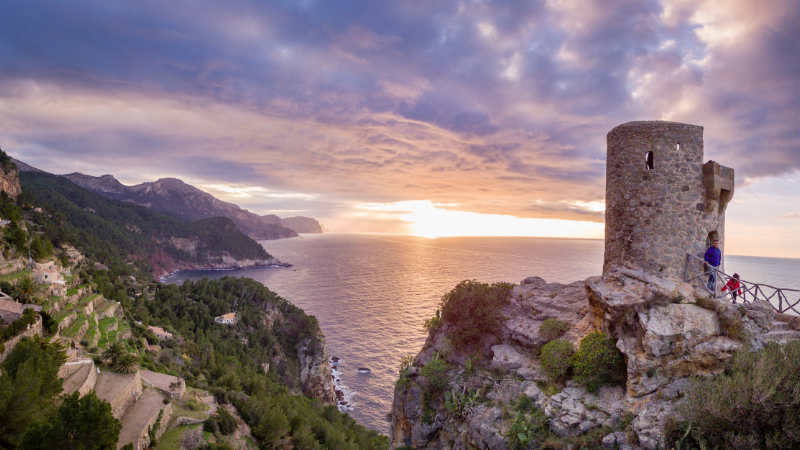
The marjades are an inseparable part of the Serra de Tramuntana landscape. This system of dry-stone terraces was inscribed by UNESCO in 2018 on the List of Intangible Cultural Heritage of Humanity, recognising that Mallorcan architecture does not end at the walls of the houses: it extends to the agricultural landscape that surrounds them. Son Marroig, in Deià, and Raixa, in Bunyola, are the most accessible examples of this ensemble.
The alquería: Islamic heritage in the countryside
One of the most significant legacies of Islamic architecture in Mallorca is the alquerías, ancient rural houses located in the countryside. With a central courtyard, enclosed structure and interior fountain, they are inspired by the principles of Islam, where privacy and the protection of domestic space were essential. Many current place names — with Arabic prefixes such as “Ben-” or “Al-” — reveal the location of these former estates, although the original buildings are rarely preserved intact.
Palma: the urban dimension of Mallorcan architecture
To speak of Mallorcan architecture without stopping in Palma is to tell only half the story. The capital concentrates the densest and most diverse built heritage on the island, where civil Gothic, Baroque and Renaissance palaces coexist in a historic centre declared a Site of Cultural Interest.
The Lonja: the most elegant civil Gothic in the Mediterranean
The Lonja of Palma — Sa Llotja in Mallorcan — is, without question, the jewel of the island’s civil Gothic architecture. It was built by master Guillem Sagrera between 1426 and 1452 to serve as the seat of the College of Merchants and the island’s government. Two types of stone were used in its construction: that of Santanyí in columns, keystones and pavements, and that of Sollerich in the spandrels of the vaults. Inside, six slender helical columns rise without base or capital to form the ribs of a ribbed vault that gives the impression of a forest of stone palm trees. Today it functions as a cultural space and temporary exhibition hall.
The Almudaina Palace and the palaces of the Born
The Royal Palace of the Almudaina dates back to the 14th century, built over an ancient Arab alcázar. Its open gallery facing the sea is a beautiful example of a Gothic portico, and its Great Hall — roofed with very flattened pointed arches — is one of the most original medieval spaces in Spain. Alongside it, the palaces of the Paseo del Born — many converted into museums, galleries or institutional headquarters — show how late Mallorcan Gothic evolved towards the Renaissance: marès facades with round-arch doorways, courtyards with interior cloisters and arcaded galleries that filter light with an almost musical precision.
The cloister of San Francisco and parish Gothic
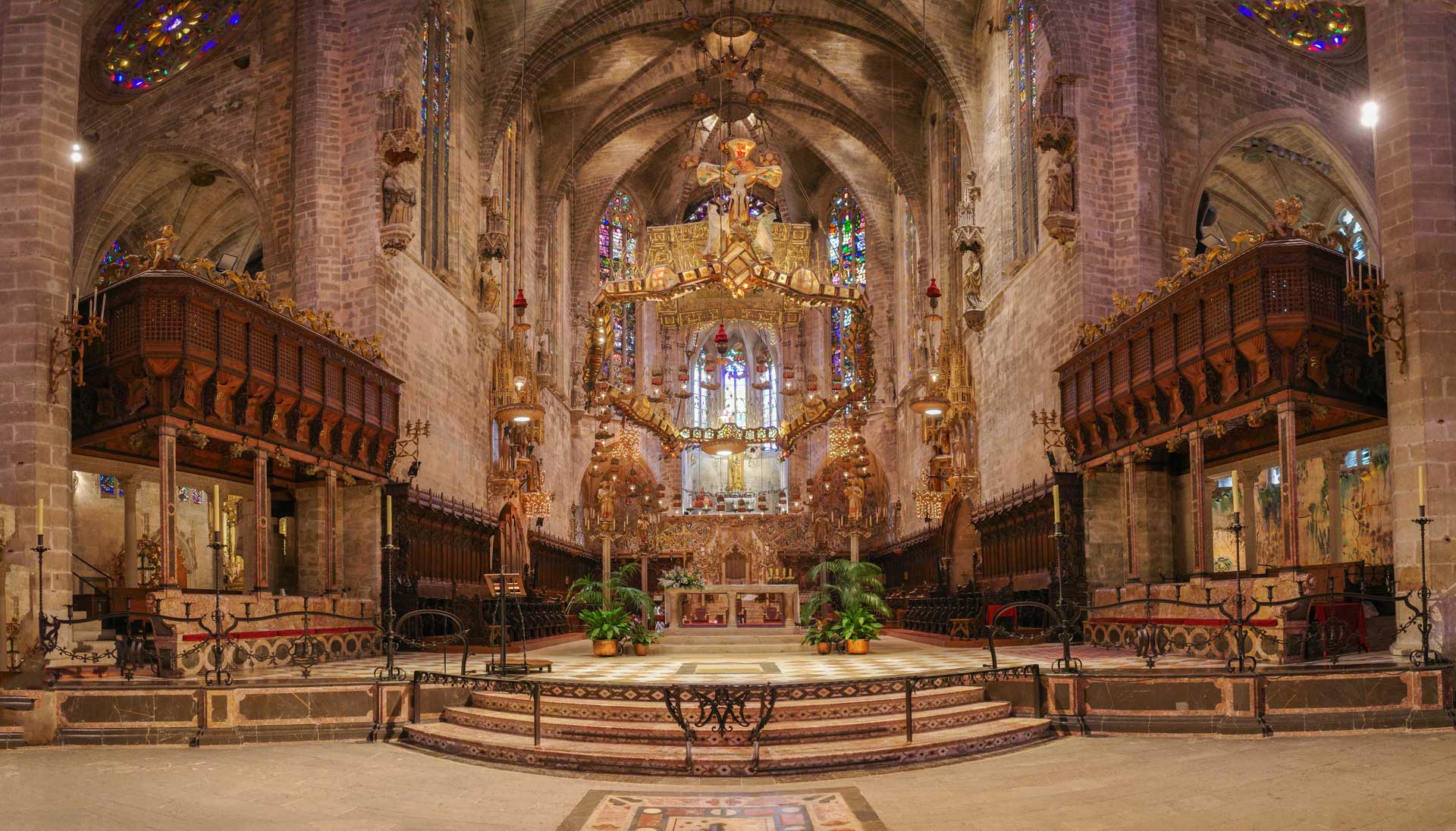
The church and cloister of San Francisco is another essential landmark: its 15th-century cloister, with bays of lobed arches, is considered the most beautiful in all of Palma. Mallorcan Gothic — austere, solid, built in marès — is one of the most original expressions of this style throughout the western Mediterranean, and Palma is its finest laboratory. If the rural world offers you the intimate scale of vernacular architecture, Palma gives you the monumental scale of a city that was, for centuries, one of the commercial capitals of the Mare Nostrum.
The villages where Mallorcan architecture shines brightest
There are places in Mallorca where vernacular architecture is not a remnant of the past but the living present of the village. Three names stand out above all others.
Fornalutx: the most photogenic village in the Tramuntana
Terraced on the hillside of the sierra, Fornalutx is a lesson in urbanism adapted to the terrain. Stone houses, wooden balconies and Arabic roof tiles are arranged on steep slopes, creating one of the best-preserved rural ensembles in the Balearic Islands. Vernacular architecture can be appreciated in details such as the green shutters, wooden doors and richly decorated eaves. From Palma, the journey takes approximately 45 minutes along the Ma-11 towards Sóller.
Deià: golden stone above the Mediterranean
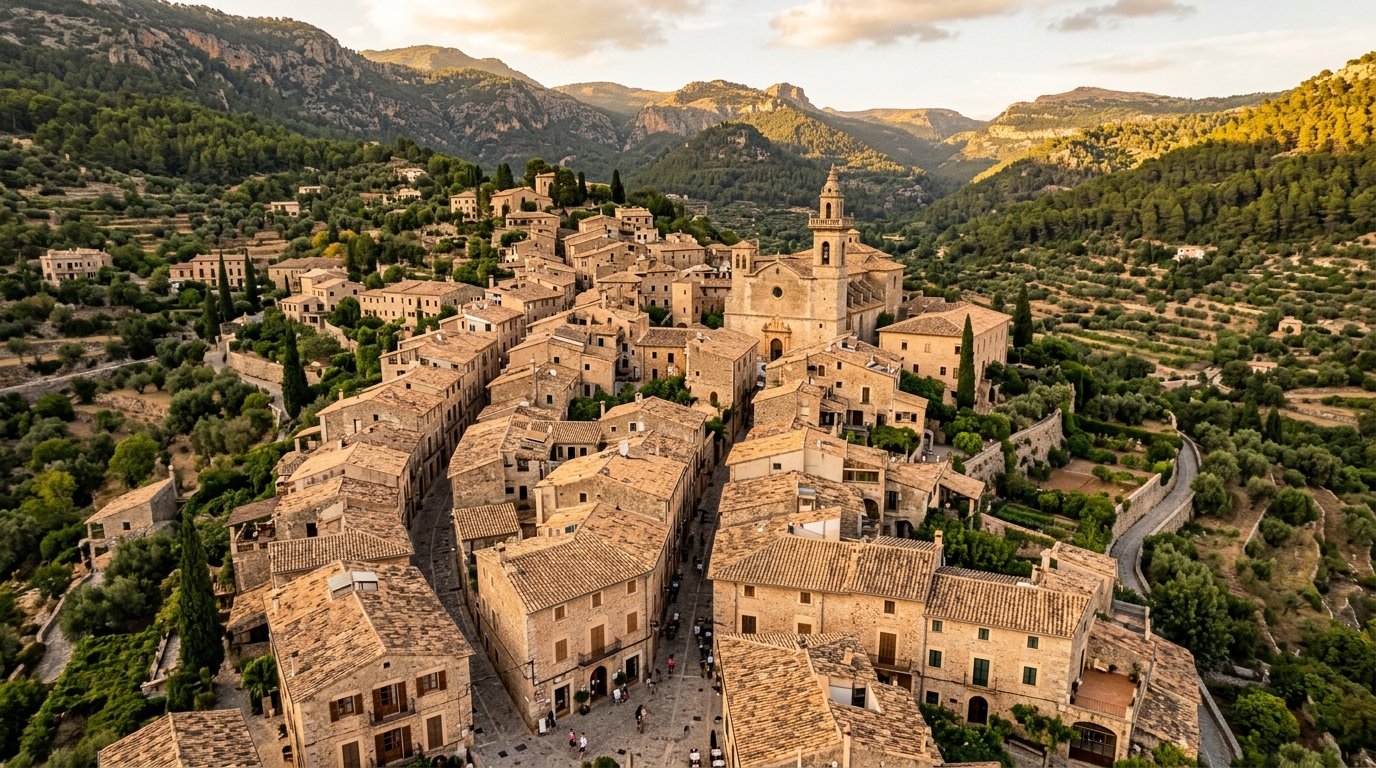
With its golden stone houses perched on a hill, Deià represents an almost sculptural architecture. The village is built vertically, following the topography, and maintains a coherent aesthetic in which colour, material and proportion are key. Located in the Serra de Tramuntana, a UNESCO World Heritage Site since 2011, Deià uniquely combines traditional Mallorcan architecture with a privileged natural setting. The coherence between construction and landscape that Deià offers is, arguably, the purest example of integration between architecture and territory on the entire island.
Valldemossa: stone, history and culture
Exposed stone, cobbled streets and sober volumes build a harmonious ensemble crowned by the Real Cartuja. Valldemossa is part of the Cultural Landscape of the Serra de Tramuntana, declared a UNESCO World Heritage Site in 2011, and stands out for its ensemble of palatial houses and its rich medieval cultural past. Walking through its streets is to understand that Mallorcan architecture is not a decorative style, but a way of life encoded in stone.
Conservation, regulations and the sustainable model
Tourist pressure and the property market have put the vernacular heritage of Mallorca under strain. However, they have also generated a growing demand for respectful restorations. One of the greatest challenges has been rehabilitating old buildings without losing their essence: preserving the wooden beams, clay tiles and exposed marès stone on facades and in the interior arches that mark the transition between spaces.
Current regulations — managed by the Consell de Mallorca through its architectural heritage protection catalogues — favour the use of local materials in interventions on historic ensembles and rural areas. The value of marès and pedra en sec lies not only in aesthetics, but in their bioclimatic response capacity and their contribution to sustainability: vernacular Mallorcan architecture is, in this sense, a model of bioconstruction avant la lettre, centuries ahead of any energy certification.
At Finca Treurer, in the heart of the Pla de Mallorca, this philosophy permeates every corner: stone, wood, centuries-old olive trees and a way of understanding the territory that connects directly with the island’s building and agricultural tradition. Visiting the estate is also reading Mallorcan architecture from the inside.
Glossary of Mallorcan architectural terms
- Marès: sedimentary calcarenite, the quintessential building stone of the Balearic Islands.
- Pedra en sec (dry stone): building technique without mortar, used in walls and marjades.
- Marjades: stepped agricultural terraces on hillsides, supported by pedra en sec walls.
- Possessió: large rural manor estate with a residence, agricultural outbuildings and often a chapel.
- Alquería: rural house of Islamic origin, with an enclosed central courtyard and interior fountain.
- Casa payesa: basic rural agricultural dwelling, with thick walls, a courtyard and a gabled roof.
- Alero: wooden or stone overhang above windows and doors that provides protection from sun and rain.
- Dovela: wedge-shaped piece that forms the arch; in Mallorca, usually carved in marès.
- Claustro: interior porticoed courtyard, typical of convents and palaces; abundant in Palma’s Gothic quarter.
- Cantería: the art of extracting, carving and placing stone; a key traditional craft in Mallorcan architecture.
Frequently asked questions
What is marès stone and why is it so important in Mallorcan architecture?
Marès is a sedimentary calcarenite — formed by the lithification of sand dunes — with a colour ranging from beige to golden. It is the most representative building material in Mallorca: easy to extract and work, it naturally regulates humidity and requires very little maintenance. It has been used since ancient times in all types of buildings, from Palma Cathedral to the humblest houses in the island’s inland villages.
Which villages in Mallorca have the best-preserved vernacular architecture?
Fornalutx, Deià and Valldemossa are the most recognised references, all in the Serra de Tramuntana, declared a UNESCO World Heritage Site in 2011. Also notable are Banyalbufar, Sóller and many inland villages such as Alaró, Sineu and Petra, where traditional Mallorcan architecture is preserved with great authenticity.
What is the difference between a casa payesa and a manor estate in Mallorca?
The casa payesa is the basic rural dwelling of the Mallorcan farmer: compact, with thick stone walls, an interior courtyard and a gabled roof. The manor estate or possessió is a much larger version that includes the owner’s residence, agricultural outbuildings, a chapel and often formal gardens with marjades. Both share the materials and constructive logic of vernacular Mallorcan architecture.
Is it worth visiting the historic architecture of Palma?
Absolutely. The Lonja (Sa Llotja), the Almudaina Palace, the Cathedral and the cloister of San Francisco form one of the most notable ensembles of civil Gothic architecture in the western Mediterranean. Many of these buildings were constructed with marès and Santanyí stone, the same materials that define the island’s rural architecture. Palma is, in this sense, the indispensable urban complement to the vernacular world of the villages.
Can traditional Mallorcan architecture be visited in the island’s interior?
Yes. The Pla de Mallorca preserves numerous estates and village houses with vernacular architecture in good condition. Municipalities such as Petra, Montuïri and Algaida offer authentic examples away from the most crowded tourist routes. Finca Treurer, in the municipality of Algaida, is a living example of how Mallorcan architecture and agricultural tradition coexist naturally.
What elements define a historic Mallorcan facade?
The most characteristic elements are: limestone or marès stone walls, round arches over doorways and windows, painted wooden shutters, wrought-iron grilles, Arabic roof tiles, wooden eaves and, in the wealthier houses, glazed ceramic details. The combination of all these elements gives Mallorcan architecture its unmistakable visual identity.